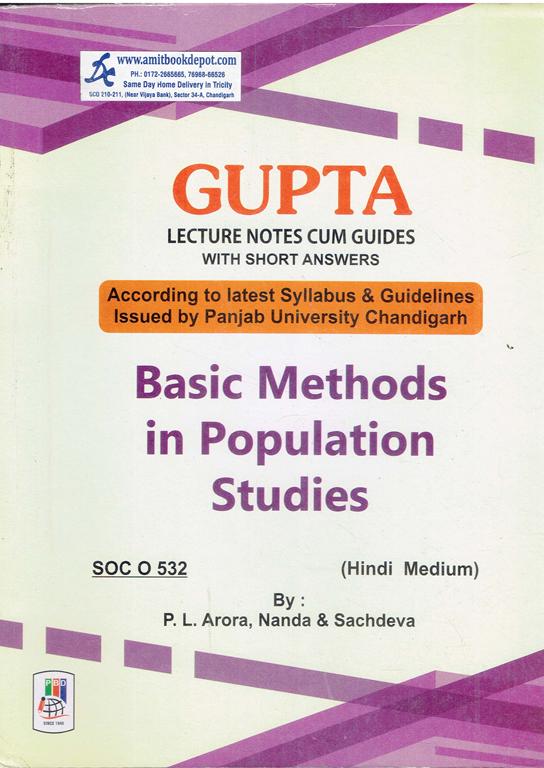
Gupta Basic Methods in Population Studies SOC O 532 for MA Sociology All UG Semester of Panjab University Chandigarh (Hindi Medium)
Gupta Basic Methods in Population Studies SOC O 532 for MA Sociology All UG Semester of Panjab University Chandigarh (Hindi Medium)
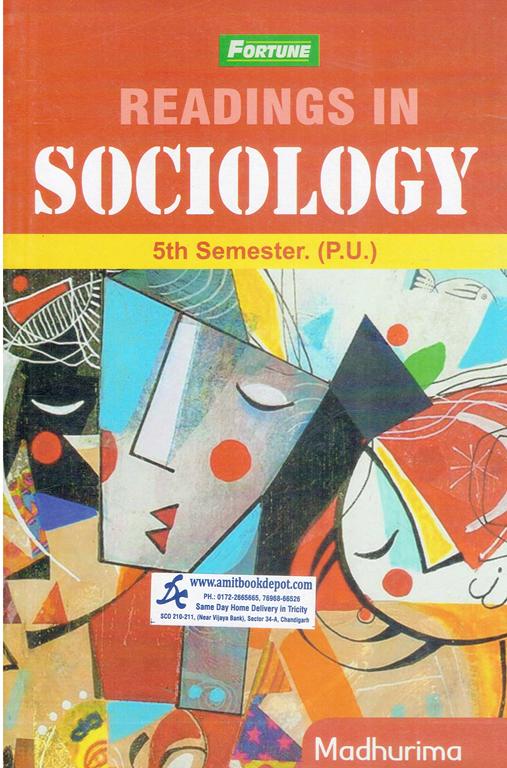
by Madhurima
₹400₹400.00(-/
off)
Rating & Reviews
23 Customer Review
"Gupta Basic Methods in Population Studies (SOC O 532)" by P.L. Arora, Nanda, and Sachdeva is the prescribed Hindi-medium book for MA Sociology and UG students of Panjab University, Chandigarh. Published by Pepsu Book Depot, it covers the complete latest syllabus on demographic methods. The book provides detailed explanations of sources of demographic data and measures of population change, composition, mortality, fertility, and marriage. Designed for exam success, it includes topics like life tables, age-sex pyramids, growth rates, and reproduction rates. It is an essential guide for mastering population studies and excelling in university examinations.
"Gupta Basic Methods in Population Studies (SOC O 532)" is the definitive Hindi medium book authored by P.L. Arora, Nanda, and Sachdeva, meticulously designed for the Master of Arts (MA) in Sociology and all Undergraduate (UG) semester students of Panjab University, Chandigarh. Published by Pepsu Book Depot, this book is an indispensable resource that strictly adheres to the latest prescribed syllabus, ensuring comprehensive coverage of every topic and examination pattern. It serves as a complete guide for mastering the quantitative and analytical techniques essential for understanding population dynamics.
The primary objective of this course, and consequently this book, is to equip students with a foundational knowledge of demographic methods. It enables learners to explore various sources of demographic data, understand basic techniques for handling this data, and develop key measures to analyze changes in population size, fertility, mortality, and marriage patterns. The book is structured to transform complex demographic concepts into accessible, exam-focused content for Hindi-medium students.
Organized systematically, the content is divided into clear units that mirror the university syllabus. Unit I delves into the fundamental sources of demographic data, providing a critical examination of the Census, Civil Registration System, National Sample Surveys, and UN data sources. It further explains core concepts of population change, detailing methods to calculate intercensal change, average annual growth rate, and different models like linear, geometric, and exponential growth rates, along with interpolation and extrapolation techniques.
Unit II focuses on population composition and distribution, analyzing metrics such as literacy rate, rural-urban distribution, and labor force participation. A significant portion is dedicated to age and sex structure, addressing common issues like age heaping, adjustments for inaccurate age data, calculation of dependency ratios, and the construction and interpretation of age-sex pyramids—a vital tool for visual demographic analysis.
Unit III provides an in-depth study of Measures of Mortality. It guides students through the computation of crucial indicators like the Crude Death Rate (CDR), Age-Specific Death Rates (ASDR), and Infant Mortality Rate (IMR), including its sub-components. The unit also offers a thorough exploration of the life table method, explaining its types, basic columns, the concept of a stationary population, and its practical applications in demographic research and insurance.
Unit IV comprehensively covers Measures of Fertility and Marriage. Students will learn to compute and interpret rates such as the Crude Birth Rate (CBR), General Fertility Rate (GFR), Age-Specific Fertility Rate (ASFR), Total Fertility Rate (TFR), and Reproduction Rates (GRR & NRR). Additionally, it covers measures related to marriage and divorce, including crude marriage and divorce rates, and methods to calculate the mean age at marriage from available data.
Beyond the core syllabus, the book includes a dedicated section for short answer questions, which is crucial for exam preparation. It strictly follows the university's examination format, detailing the paper structure: a compulsory short answer question with 10 parts (20 marks) and four long answer questions with internal choice (15 marks each), totalling 80 marks for theory, with 20 marks allocated for internal assessment. A special note for private candidates regarding mark calculation is also included as per syllabus instructions.
"Gupta Basic Methods in Population Studies" is more than just a book; it is a tailored academic companion. Its clear Hindi language presentation, alignment with Panjab University's evaluation scheme, and focus on practical computation make it the most reliable resource for securing high marks. For any student pursuing an MA in Sociology or relevant UG courses at Panjab University, Chandigarh, this book is the essential key to building a strong conceptual foundation and achieving academic success in demographic studies and population analysis.
Is this book the latest edition and fully updated for the current academic year's syllabus of Panjab University?
A1
Yes, this book is meticulously compiled based on the latest prescribed syllabus for SOC O 532: Basic Methods in Population Studies at Panjab University, Chandigarh.
Q2
I am a private candidate. Does this book include guidance on how my final marks are calculated?
A2
Absolutely. The book contains the specific note from the syllabus regarding mark calculation for private candidates, explaining how theory paper marks are proportionately increased in lieu of internal assessment.
Q3
Does the book cover the exact structure of the university exam paper?
A3
Yes, it provides detailed instructions on the paper pattern: 80 marks for theory (with a compulsory short answer question and 4 long answer questions with choice) and 20 marks for internal assessment.
Q4
Are practical calculation methods for demographic rates like CDR, ASFR, TFR, and IMR explained with examples?
A4
Yes, the book dedicates entire units to the computation and application of all key demographic measures, including Crude Death Rate, Age-Specific Fertility Rate, Total Fertility Rate, and Infant Mortality Rate, with a focus on the Indian context.
Q5
Is the topic of Life Tables covered in a beginner-friendly manner for sociology students?
A5
Yes, Unit III explains the Life Table method in detail, including its types, basic columns, the concept of a stationary population, and its applications, making it accessible for students without an advanced statistics background.
Q6
Does it discuss the problems associated with demographic data sources in India, like age heaping?
A6
Yes, it critically examines the nature and quality of data from sources like the Census and surveys, and specifically addresses issues such as age heaping and methods for adjusting age data.
Q7
Are marriage and divorce metrics, like Mean Age at Marriage, part of the content?
A7
Yes, Unit IV includes measures of marriage and divorce, including the calculation of the mean age at marriage from census and survey data.
Q8
Does it cover theories of population change, like the Demographic Transition Theory?
A8
Yes, the content includes a discussion on the major theories of demographic change, providing a theoretical context for the quantitative methods.
Q9
Are topics like Contraceptive Prevalence Rate (CPR) and Fetal Wastage included?
A9
Yes, as per the detailed syllabus, measures like the Contraceptive Prevalence Rate and indicators related to fetal wastage are covered under the fertility measures in Unit IV.
Q10
How does the book help in understanding population growth rates (linear, geometric, exponential)?
A10
Unit I provides formulas and explanations for calculating different types of population growth rates—linear, geometric, and exponential—which are fundamental for analyzing intercensal change.
0.00
0 Overall Rating
5
0
4
0
3
0
2
0
1
0
Try this product & share your review &
thoughts
UNIT - I
1. Sources of Demographic Data
2. Change in Population Size
3. Structure and division of population
(Population Composition and Distribution)
UNIT - II
4. Age and Gender Structure
5. Death rate in India
6. Life Table
(Life Table)
UNIT - III
7. Birth Rate and Fertility in India
8. Theories of Demographic Change
9. Divorce and Widow Remarriage
(Short Answer Questions)
Latest Syllabus of Basic Methods in Population Studies SOC O 532 for MA Sociology All UG Semester of Panjab University Chandigarh (Hindi Medium),
SOC O 532: BASIC METHODS IN POPULATION STUDIES
Objective
To understand the basic dynamics of population, it is important to have basic knowledge of demographic methods. This course prepares the students to explore the sources of demographic data, learn basic techniques to handle these data, and develop measures to understand changes in population size, fertility, mortality, and marriage.
INSTRUCTIONS FOR THE PAPER-SETTER AND THE CANDIDATES
(i) The theory question paper will be of 80 marks, and 20 marks will be for internal assessment. The duration of the paper will be 3 hours.
(ii) For private candidates, who have not been assessed earlier for internal assessment, the marks secured by them in the theory paper will proportionately be increased to the maximum marks of the paper in lieu of internal assessment.
The paper setter must put note (ii) in the question paper.
The syllabus has been divided into four units.
There shall be 9 questions in all. The first question is compulsory and shall be a short answer type containing 10 short questions spread over the whole syllabus to be answered in about 30 to 35 words each, carrying 20 marks, i.e., 2 marks each. The rest of the paper shall contain 4 units. Each unit shall have two long questions and the Candidates shall be given an internal choice of attempting one question from each unit—4 in all. Each question will carry 15 marks.
Course Outline
Unit-I
Sources of Demographic Data: Census, Civil Registration, Population Surveys, and UN Sources of Demographic Data. Nature and Quality of These Data Sources.
Changes in Population Size: Intercensal Change, Average Annual Growth Rate, Linear Growth Rate, Geometric Growth Rate, Exponential Growth Rate, Interpolation, and Extrapolation.
Unit-II
Population Composition and Distribution: Literacy Rate, Rural-Urban, and Labor Force Participation Rate.
Age and Sex Composition: Problems related to Age Data, Age Distribution, Age Heaping Effects, and Adjustment of Age Data. Dependency Ratios. Construction of age-sex pyramids and sex ratio.
Unit III
Measures of Mortality: Computation of Crude Death Rate, Age-Specific Death Rates, Infant Mortality Rate, Perinatal, Neonatal, and Post-Neonatal Mortality Rate.
Life-Table Method: Types of Life Tables, Basic Columns of Life Tables. Life Table Stationary Population. Application of the life table approach.
Unit IV
Measures of Fertility: Computation of Crude Birth Rate and its uses, General Fertility Rate, Age-Specific Fertility Rate, Total Fertility Rate, Gross Reproduction Rate, Net Reproduction Rate, Child-Woman Ratio Contraceptive Prevalence Rate, Abortion Rate & Fetal Wastage
Measure of Marriage & Divorce: Crude Marriage Rate, Divorce Rate. Mean Age at Marriage from Census and Survey Data.
"Gupta Basic Methods in Population Studies (SOC O 532)" is the definitive Hindi medium book authored by P.L. Arora, Nanda, and Sachdeva, meticulously designed for the Master of Arts (MA) in Sociology and all Undergraduate (UG) semester students of Panjab University, Chandigarh. Published by Pepsu Book Depot, this book is an indispensable resource that strictly adheres to the latest prescribed syllabus, ensuring comprehensive coverage of every topic and examination pattern. It serves as a complete guide for mastering the quantitative and analytical techniques essential for understanding population dynamics.
The primary objective of this course, and consequently this book, is to equip students with a foundational knowledge of demographic methods. It enables learners to explore various sources of demographic data, understand basic techniques for handling this data, and develop key measures to analyze changes in population size, fertility, mortality, and marriage patterns. The book is structured to transform complex demographic concepts into accessible, exam-focused content for Hindi-medium students.
Organized systematically, the content is divided into clear units that mirror the university syllabus. Unit I delves into the fundamental sources of demographic data, providing a critical examination of the Census, Civil Registration System, National Sample Surveys, and UN data sources. It further explains core concepts of population change, detailing methods to calculate intercensal change, average annual growth rate, and different models like linear, geometric, and exponential growth rates, along with interpolation and extrapolation techniques.
Unit II focuses on population composition and distribution, analyzing metrics such as literacy rate, rural-urban distribution, and labor force participation. A significant portion is dedicated to age and sex structure, addressing common issues like age heaping, adjustments for inaccurate age data, calculation of dependency ratios, and the construction and interpretation of age-sex pyramids—a vital tool for visual demographic analysis.
Unit III provides an in-depth study of Measures of Mortality. It guides students through the computation of crucial indicators like the Crude Death Rate (CDR), Age-Specific Death Rates (ASDR), and Infant Mortality Rate (IMR), including its sub-components. The unit also offers a thorough exploration of the life table method, explaining its types, basic columns, the concept of a stationary population, and its practical applications in demographic research and insurance.
Unit IV comprehensively covers Measures of Fertility and Marriage. Students will learn to compute and interpret rates such as the Crude Birth Rate (CBR), General Fertility Rate (GFR), Age-Specific Fertility Rate (ASFR), Total Fertility Rate (TFR), and Reproduction Rates (GRR & NRR). Additionally, it covers measures related to marriage and divorce, including crude marriage and divorce rates, and methods to calculate the mean age at marriage from available data.
Beyond the core syllabus, the book includes a dedicated section for short answer questions, which is crucial for exam preparation. It strictly follows the university's examination format, detailing the paper structure: a compulsory short answer question with 10 parts (20 marks) and four long answer questions with internal choice (15 marks each), totalling 80 marks for theory, with 20 marks allocated for internal assessment. A special note for private candidates regarding mark calculation is also included as per syllabus instructions.
"Gupta Basic Methods in Population Studies" is more than just a book; it is a tailored academic companion. Its clear Hindi language presentation, alignment with Panjab University's evaluation scheme, and focus on practical computation make it the most reliable resource for securing high marks. For any student pursuing an MA in Sociology or relevant UG courses at Panjab University, Chandigarh, this book is the essential key to building a strong conceptual foundation and achieving academic success in demographic studies and population analysis.
Is this book the latest edition and fully updated for the current academic year's syllabus of Panjab University?
A1
Yes, this book is meticulously compiled based on the latest prescribed syllabus for SOC O 532: Basic Methods in Population Studies at Panjab University, Chandigarh.
Q2
I am a private candidate. Does this book include guidance on how my final marks are calculated?
A2
Absolutely. The book contains the specific note from the syllabus regarding mark calculation for private candidates, explaining how theory paper marks are proportionately increased in lieu of internal assessment.
Q3
Does the book cover the exact structure of the university exam paper?
A3
Yes, it provides detailed instructions on the paper pattern: 80 marks for theory (with a compulsory short answer question and 4 long answer questions with choice) and 20 marks for internal assessment.
Q4
Are practical calculation methods for demographic rates like CDR, ASFR, TFR, and IMR explained with examples?
A4
Yes, the book dedicates entire units to the computation and application of all key demographic measures, including Crude Death Rate, Age-Specific Fertility Rate, Total Fertility Rate, and Infant Mortality Rate, with a focus on the Indian context.
Q5
Is the topic of Life Tables covered in a beginner-friendly manner for sociology students?
A5
Yes, Unit III explains the Life Table method in detail, including its types, basic columns, the concept of a stationary population, and its applications, making it accessible for students without an advanced statistics background.
Q6
Does it discuss the problems associated with demographic data sources in India, like age heaping?
A6
Yes, it critically examines the nature and quality of data from sources like the Census and surveys, and specifically addresses issues such as age heaping and methods for adjusting age data.
Q7
Are marriage and divorce metrics, like Mean Age at Marriage, part of the content?
A7
Yes, Unit IV includes measures of marriage and divorce, including the calculation of the mean age at marriage from census and survey data.
Q8
Does it cover theories of population change, like the Demographic Transition Theory?
A8
Yes, the content includes a discussion on the major theories of demographic change, providing a theoretical context for the quantitative methods.
Q9
Are topics like Contraceptive Prevalence Rate (CPR) and Fetal Wastage included?
A9
Yes, as per the detailed syllabus, measures like the Contraceptive Prevalence Rate and indicators related to fetal wastage are covered under the fertility measures in Unit IV.
Q10
How does the book help in understanding population growth rates (linear, geometric, exponential)?
A10
Unit I provides formulas and explanations for calculating different types of population growth rates—linear, geometric, and exponential—which are fundamental for analyzing intercensal change.
Latest Syllabus of Basic Methods in Population Studies SOC O 532 for MA Sociology All UG Semester of Panjab University Chandigarh (Hindi Medium),
SOC O 532: BASIC METHODS IN POPULATION STUDIES
Objective
To understand the basic dynamics of population, it is important to have basic knowledge of demographic methods. This course prepares the students to explore the sources of demographic data, learn basic techniques to handle these data, and develop measures to understand changes in population size, fertility, mortality, and marriage.
INSTRUCTIONS FOR THE PAPER-SETTER AND THE CANDIDATES
(i) The theory question paper will be of 80 marks, and 20 marks will be for internal assessment. The duration of the paper will be 3 hours.
(ii) For private candidates, who have not been assessed earlier for internal assessment, the marks secured by them in the theory paper will proportionately be increased to the maximum marks of the paper in lieu of internal assessment.
The paper setter must put note (ii) in the question paper.
The syllabus has been divided into four units.
There shall be 9 questions in all. The first question is compulsory and shall be a short answer type containing 10 short questions spread over the whole syllabus to be answered in about 30 to 35 words each, carrying 20 marks, i.e., 2 marks each. The rest of the paper shall contain 4 units. Each unit shall have two long questions and the Candidates shall be given an internal choice of attempting one question from each unit—4 in all. Each question will carry 15 marks.
Course Outline
Unit-I
Sources of Demographic Data: Census, Civil Registration, Population Surveys, and UN Sources of Demographic Data. Nature and Quality of These Data Sources.
Changes in Population Size: Intercensal Change, Average Annual Growth Rate, Linear Growth Rate, Geometric Growth Rate, Exponential Growth Rate, Interpolation, and Extrapolation.
Unit-II
Population Composition and Distribution: Literacy Rate, Rural-Urban, and Labor Force Participation Rate.
Age and Sex Composition: Problems related to Age Data, Age Distribution, Age Heaping Effects, and Adjustment of Age Data. Dependency Ratios. Construction of age-sex pyramids and sex ratio.
Unit III
Measures of Mortality: Computation of Crude Death Rate, Age-Specific Death Rates, Infant Mortality Rate, Perinatal, Neonatal, and Post-Neonatal Mortality Rate.
Life-Table Method: Types of Life Tables, Basic Columns of Life Tables. Life Table Stationary Population. Application of the life table approach.
Unit IV
Measures of Fertility: Computation of Crude Birth Rate and its uses, General Fertility Rate, Age-Specific Fertility Rate, Total Fertility Rate, Gross Reproduction Rate, Net Reproduction Rate, Child-Woman Ratio Contraceptive Prevalence Rate, Abortion Rate & Fetal Wastage
Measure of Marriage & Divorce: Crude Marriage Rate, Divorce Rate. Mean Age at Marriage from Census and Survey Data.
0.00
0 Overall Rating
5
0
4
0
3
0
2
0
1
0
Try this product & share your review &
thoughts
Top Trending Product
Related
Product
Related Product
Related Blog Posts
Latest Blogs
Latest Blogs
Classic Literature Reimagined: Discuss modern twists on classic novels.
Lorem ipsum dolor sit amet, consectetur adipiscing elit, sed
do
eiusmod tempor incididunt ut labore et dolore magna aliqua. Ut enim ad minim
veniam, quis nostrud exercitation ullamco Lorem ipsum dolor sit amet,
consectetur adipiscing elit, sed do eiusmod tempor incididunt ut labore et
dolore magna aliqua. Utenim ad minim veniam, quis nostrud exercitation
ullamco
Lorem ipsum dolor sit amet, consecte...
Classic Literature Reimagined: Discuss modern twists on classic novels.
Lorem ipsum dolor sit amet, consectetur adipiscing elit, sed
do
eiusmod tempor incididunt ut labore et dolore magna aliqua. Ut enim ad minim
veniam, quis nostrud exercitation ullamco Lorem ipsum dolor sit amet,
consectetur adipiscing elit, sed do eiusmod tempor incididunt ut labore et
dolore magna aliqua. Utenim ad minim veniam, quis nostrud exercitation
ullamco
Lorem ipsum dolor sit amet, consecte...
Classic Literature Reimagined: Discuss modern twists on classic novels.
Lorem ipsum dolor sit amet, consectetur adipiscing elit, sed
do
eiusmod tempor incididunt ut labore et dolore magna aliqua. Ut enim ad minim
veniam, quis nostrud exercitation ullamco Lorem ipsum dolor sit amet,
consectetur adipiscing elit, sed do eiusmod tempor incididunt ut labore et
dolore magna aliqua. Utenim ad minim veniam, quis nostrud exercitation
ullamco
Lorem ipsum dolor sit amet, consecte...