-
Mon-Fri: 10AM to 8PM 01722665665
-
My Account
-
-
0
Total :
₹ 0.00

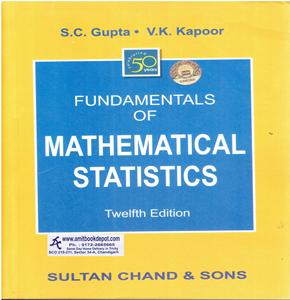

Yes, the comprehensive coverage of probability, inference, and sampling distributions makes it an excellent foundational resource for exams like ISS, UGC-NET in Statistics, and other similar competitive tests.
This edition typically contains a vast number of solved examples within the chapters. However, a separate solution manual may be available for purchase; you should check with the publisher or your bookstore for its availability.
While Spiegel is excellent for applied problems, Gupta & Kapoor offers a more rigorous, mathematically-oriented approach, making it better suited for in-depth theoretical understanding, especially for honours and postgraduate courses.
Yes, this topic is crucial for numerical methods, interpolation, and solving difference equations, which are applied in areas like actuarial science, econometrics, and advanced statistical modeling.
Yes, the appendix includes essential statistical tables (Z, t, Chi-square, F), which are typically sufficient for solving problems in university exams and homework assignments.
Yes, Chapter 20 is dedicated to "Bivariate and Multivariate Normal Distribution," which is an advanced topic not always covered in introductory texts but is vital for higher studies.
This is a classical statistics topic dealing with the analysis of qualitative data (attributes) like gender, literacy, etc., using techniques such as consistency of data, association of attributes, and Yule's coefficient.
Due to its depth and theoretical nature, it is an excellent resource for self-study for highly motivated learners with a strong mathematical foundation. However, beginners may benefit from supplementary instruction.
No, this textbook focuses exclusively on the mathematical theory and manual calculation methods of statistics. It does not cover software like R, SPSS, or Excel.
Chapter 7 covers Probability Generating Functions (PGF) and Moment Generating Functions (MGF) in detail, explaining their role in characterizing distributions and proving laws like the Law of Large Numbers.
No Description Added
Yes, the comprehensive coverage of probability, inference, and sampling distributions makes it an excellent foundational resource for exams like ISS, UGC-NET in Statistics, and other similar competitive tests.
This edition typically contains a vast number of solved examples within the chapters. However, a separate solution manual may be available for purchase; you should check with the publisher or your bookstore for its availability.
While Spiegel is excellent for applied problems, Gupta & Kapoor offers a more rigorous, mathematically-oriented approach, making it better suited for in-depth theoretical understanding, especially for honours and postgraduate courses.
Yes, this topic is crucial for numerical methods, interpolation, and solving difference equations, which are applied in areas like actuarial science, econometrics, and advanced statistical modeling.
Yes, the appendix includes essential statistical tables (Z, t, Chi-square, F), which are typically sufficient for solving problems in university exams and homework assignments.
Yes, Chapter 20 is dedicated to "Bivariate and Multivariate Normal Distribution," which is an advanced topic not always covered in introductory texts but is vital for higher studies.
This is a classical statistics topic dealing with the analysis of qualitative data (attributes) like gender, literacy, etc., using techniques such as consistency of data, association of attributes, and Yule's coefficient.
Due to its depth and theoretical nature, it is an excellent resource for self-study for highly motivated learners with a strong mathematical foundation. However, beginners may benefit from supplementary instruction.
No, this textbook focuses exclusively on the mathematical theory and manual calculation methods of statistics. It does not cover software like R, SPSS, or Excel.
Chapter 7 covers Probability Generating Functions (PGF) and Moment Generating Functions (MGF) in detail, explaining their role in characterizing distributions and proving laws like the Law of Large Numbers.