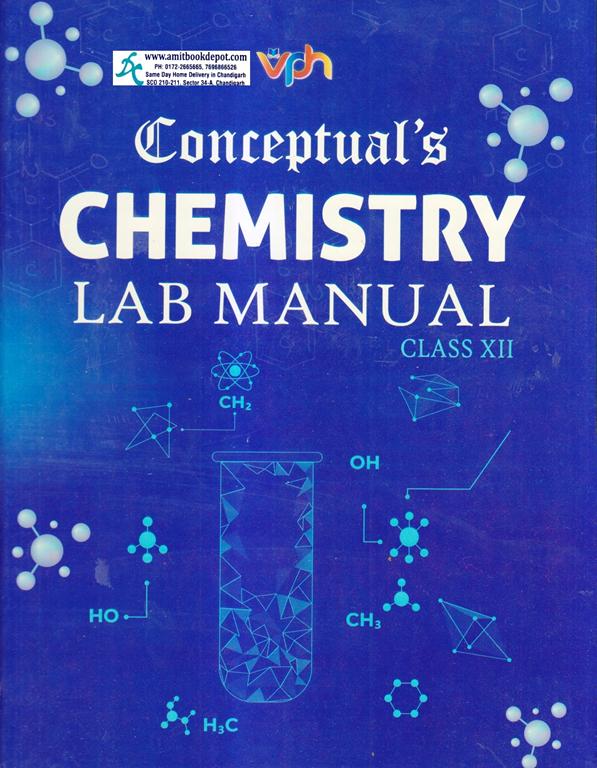
Vohra Conceptual Chemistry Lab Manual for Class 12th
Vohra Conceptual Chemistry Lab Manual for Class 12th
by Madhurima
₹383₹383.00(-/
off)
Rating & Reviews
23 Customer Review
Vohra Conceptual Chemistry Lab Manual for Class 12 by Ms Tejinder Sondhi (Vohra Publishing House) is a complete practical guide aligned with the latest CBSE syllabus. It covers surface chemistry (lyophilic & lyophobic sols), chemical kinetics, thermochemistry (enthalpy of neutralisation), electrochemistry (Daniell cell potential), paper chromatography (Rf values), preparation of Mohr’s salt and potash alum, organic syntheses (acetanilide & dibenzal acetone), functional group tests, biomolecule detection, volumetric analysis (KMnO₄ vs oxalic acid), and qualitative salt analysis. Includes 8 investigatory projects.
Vohra Conceptual Chemistry Lab Manual for Class 12 (Author: Ms Tejinder Sondhi, Publisher: Vohra Publishing House) is a meticulously crafted laboratory companion designed exclusively for CBSE and state board students. This lab manual bridges the critical gap between theoretical chemistry concepts and their practical application, ensuring learners develop robust experimental, analytical, and volumetric analysis skills required for board practical examinations and competitive assessments like NEET and JEE.
Aligned with the latest CBSE practical syllabus, this manual provides a systematic, step-by-step methodology for performing experiments across eleven key sections. Each experiment is presented with clear objectives, principle-based theory, apparatus requirements, procedure, observation tables, and viva-voce questions to reinforce conceptual clarity. The book emphasises micro-chemical methods wherever possible, promoting economical and safe use of reagents.
Section-wise coverage includes:
- Surface Chemistry: Hands-on preparation of lyophilic sols (starch, egg albumin, gum arabic) and lyophobic sols (aluminium hydroxide, ferric hydroxide, arsenious sulphide). Students learn dialysis for purification and study emulsifying agents’ effectiveness using castor oil, olive oil, and coconut oil.
- Chemical Kinetics: Detailed study of reaction rate dependence on concentration and temperature, including the iodine clock reaction between potassium iodate and sodium sulphite.
- Thermochemistry: Determination of enthalpy of dissolution (potassium nitrate), enthalpy of neutralisation (HCl-NaOH), and enthalpy change during hydrogen bond formation between acetone and chloroform.
- Electrochemistry: Variation of cell potential in a Daniell cell (Zn/Zn²⁺||Cu²⁺/Cu) by changing electrolyte concentrations.
- Chromatography: Separation of plant pigments from leaves and flowers using paper chromatography, calculation of Rf values, and separation of inorganic cations like Cu²⁺ and Cd²⁺.
- Preparation of Inorganic Compounds: Crystallisation of Mohr’s salt (ferrous ammonium sulphate), potash alum, and potassium ferrioxalate.
- Preparation of Organic Compounds: Synthesis of acetanilide, dibenzal acetone, p-nitroacetanilide, and 2-naphthol aniline dye.
- Tests for Functional Groups: Identification of unsaturation, alcoholic, phenolic, aldehydic, ketonic, carboxylic, and amino groups.
- Study of Biomolecules: Characteristic tests for carbohydrates, fats, and proteins in pure samples and their detection in given foodstuffs.
- Volumetric Analysis: Molarity and strength determination of KMnO₄ using standard solutions of oxalic acid and Mohr’s salt, including water of crystallisation and percentage purity calculations.
- Qualitative Analysis: Systematic salt analysis for one cation and one anion (Pb²⁺, Cu²⁺, Al³⁺, Fe³⁺, Ni²⁺, Ca²⁺, Ba²⁺, Mg²⁺, NH₄⁺; anions including CO₃²⁻, S²⁻, Cl⁻, Br⁻, I⁻, NO₃⁻, SO₄²⁻, PO₄³⁻, etc.).
Additionally, the manual includes 8 investigatory projects—from studying oxalate ions in guava to extraction of essential oils from saunf and ajwain—encouraging scientific enquiry beyond the curriculum.
Written by Ms Tejinder Sondhi in an error-free, exam-oriented language, this Vohra Conceptual Chemistry Lab Manual for Class 12th is indispensable for scoring full marks in practical exams. Its structured layout, combined with precautions and alternative procedures, makes it suitable for both school laboratories and home self-study.
Which lyophobic sols are prepared using this lab manual?
A1
Aluminium hydroxide, ferric hydroxide, and arsenious sulphide sols are prepared as lyophobic sols under Section A.
Q2
What is the aim of Experiment 3.2 in thermochemistry?
A2
To determine enthalpy of neutralisation of strong acid (HCl) with strong base (NaOH) using calorimetric measurements.
Q3
Which experiment studies variation of Daniell cell potential?
A3
Experiment 4.1 studies cell potential variation of Zn/Zn²⁺
Q4
How are Rf values determined in chromatography experiments?
A4
By measuring distance moved by solute and solvent front on paper; Rf = solute distance / solvent distance.
Q5
Name the double salt prepared in Section F of this manual.
A5
Ferrous ammonium sulphate [FeSO₄(NH₄)₂SO₄].6H₂O, commonly known as Mohr’s salt, is prepared.
Q6
Which organic dye synthesis is included in Experiment 7.4?
A6
Pure sample of 2-naphthol aniline dye (an azo dye) is prepared in Experiment 7.4.
Q7
How does Experiment 10.3 determine water of crystallisation?
A7
By titrating hydrated oxalic acid with standard M/10 KMnO₄ and calculating x in (COOH)₂.xH₂O.
Q8
Which food adulterants are studied in the investigatory projects?
A8
Common adulterants in fat, oil, butter, sugar, turmeric powder, chilli powder, and pepper are tested.
Q9
What is the clock reaction experiment in chemical kinetics?
A9
Experiment 2.4 studies reaction rate between KIO₃ and Na₂SO₃ in acidic medium using starch as indicator.
Q10
Which cations are covered in qualitative analysis salt testing?
A10
Pb²⁺, Cu²⁺, Al³⁺, Fe³⁺, Mn²⁺, Zn²⁺, Ni²⁺, Ca²⁺, Sr²⁺, Ba²⁺, Mg²⁺, and NH₄⁺ are included.
0.00
0 Overall Rating
5
0
4
0
3
0
2
0
1
0
Try this product & share your review &
thoughts
Section A: Surface Chemistry
Experiment-1.1
To prepare a colloidal sol of starch.
Experiment-1.2
To prepare a colloidal sol of egg albumin.
Experiment-1.3
To prepare a colloidal sol of gum arabic.
Experiment-1.4
To prepare aluminium hydroxide sol.
Experiment-1.3
To prepare ferric hydroxide sol.
Experiment-1.6
To prepare arsenious sulphide sol.
Experiment-1.7
To purify a colloidal solution of starch or egg albumin containing sodium chloride as an impurity.
Experiment-1.8
To study the effectiveness of different oils (castor oil, olive oil, coconut oil, cotton seed oil and mustard oil) in forming emulsions.
Experiment-1.9
To compare the effectiveness of a number of emulsifying agents in the formation of emulsions.
Section B: Chemical Kinetics
Experiment-2.1
To study the effect of concentration on the rate of reaction between sodium thiosulphate and hydrochloric acid.
Experiment-2.2
To study the effect of temperature on the rate of reaction between sodium thiosulphate and hydrochloric acid.
Experiment-2.3
To study the rate of reaction between hydrogen peroxide (H₂O₂) and iodide ion (I) at room temperature using different concentrations of iodide ion.
Experiment-2.4
To study the rate of reaction between potassium iodate and sodium sulphite in an acidic medium using starch solution as an indicator.
Section C: Thermochemistry
Experiment-3.1
To determine the enthalpy of dissolution of potassium nitrate.
Experiment-3.2
To determine the enthalpy of neutralisation of a strong acid (HCl) with a strong base (NaOH).
Experiment-3.3
C& To determine the enthalpy change during the interaction (hydrogen bond formation) of acetone and chloroform.
Section D: Electrochemistry
Experiment-4.1
To study the variation in cell potential of the Daniell cell Zn/Zn||Cu"/Cu on changing the concentration of ZnSO₄ and CuSO₄
Section E: Chromatography
Experiment-5.1
To separate pigments from extracts of leaves and flowers by paper chromatography and to determine their R values.
Experiment-5.2
To separate constituents present in an inorganic mixture containing two cations only having a large difference in R value. For example, Cu²⁺ and Cd²⁺ ions.
Section F: Preparation of Inorganic Compounds
Experiment-6.1
To prepare a double salt of ferrous ammonium sulphate [FeSO₄(NH₄)₂SO₄].6H₂O, or Mohr's salt.
Experiment-6.2
To prepare crystals of potash alum K₂SO₄ , Al(SO), 24H,O
Experiment-6.3
To prepare a pure sample of potassium ferroxalate K₂[Fe(C₂O)₃].3H₂O.,O.
Section G: Preparation of Organic Compounds
Experiment-7.1
To prepare a sample of acetanilide (C,H,NHCOCH₃),
Experiment-7.2
To prepare a sample of dibenzal acetone C6,H5-CH = CH-CO-CH = CH-C6,H5.
Experiment-7.3
To prepare a pure sample of p-nitroacetanilide.
Experiment-7.4
To prepare a pure sample of 2-naphthol aniline dye.
Section H: Tests for Functional Groups Present in Organic Compounds
Experiment-8.1
To identify the functional group present in the given organic compound.
Section I: Study of Carbohydrates, Fats and Protein in the Pure Form and Detection of Their Presence in Given Foodstuff
Experiment-9.1
To analyse the given sample of carbohydrates.
Experiment-9.2
To analyse the given sample of proteins.
Experiment-9.3
To analyse the given sample of fats and oils.
Section-J: Volumetric Analysis
Experiment-10.1
To prepare an M/20 solution of Mohr's salt. Using this solution, determine the molarity and strength of the given solution of potassium permanganate (KMnO).
Experiment-10.2
To prepare a standard solution of M/50 of oxalic acid. Using this solution, determine the molarity of the given KMnO₄ solution.
Experiment-10.3
You are given a sample of oxalic acid (COOH), XH₂O. Find out the number of molecules of water of crystallisation in the sample using an M/10 KMnO solution.
Experiment-10.4
You are provided with an M/20 solution of Mohr's salt. Using this solution, find out the molarity, strength and percentage purity of a sample of KMnO₂, 2.0 g of which has been dissolved per litre of the given KMnO₂ solution.
Experiment-10.5
You are given a solution prepared by dissolving 1.6 g per litre of the permanganate or an alkali metal, i.e., AMnO. Determine volumetrically the atomic mass of the alkali metal. Prepare M/20 Mohr's salt solution.
Section K: Qualitative Analysis
Experiment-11
To analyse the given salt for acid and basic radicals.
Investigatory Projects
Projects 1 to 8
PRACTICAL SYLLABUS (60 Periods)
Micro-chemical methods are available for several experiments. Wherever possible, such techniques should be used.
A. Surface Chemistry
(a) Preparation of one lyophilic and one lyophobic sol.
Lyophilic sol starch, egg albumin and gum.
Lyophobic sols: aluminium hydroxide, ferric hydroxide, and arsenous sulphide.
(b) Dialysis of sol prepared in (a) above.
(c) Study of the role of emulsifying agents in stabilising the emulsions of different oils.
B. Chemical Kinetics
(a) Effect of concentration and temperature on the rate of reaction between sodium thiosulphate and hydrochloric acid.
(b) Study of reaction rates of any one of the following:
(i)Reaction of iodide ions with hydrogen peroxide at room temperature using different concentrations of iodide ions.
(ii) Reaction between potassium iodate (KIO₃) and sodium sulphite (Na₂SO₃) using starch solution as an indicator (clock reaction).
C. Thermochemistry
Any one of the following experiments:
(i)Enthalpy of dissolution of copper sulphate or potassium nitrate.
(ii) Enthalpy of neutralisation of strong acid (HCl) and strong base (NaOH).
(iii) Determination of enthalpy change during interaction (hydrogen bond formation) between acetone and chloroform.
D. Electrochemistry
Variation of cell potential in Zn/Zn²⁺ and Cu/Cu²⁺ with change in concentration of electrolytes (CuSO₄ or ZnSO₄) at room temperature.
E. Chromatography
(i)Separation of pigments from extracts of leaves and flowers by paper chromatography and determination of R values.
(ii) Separation of pigments present in an inorganic mixture containing two cations only (constituents having a wide difference in R, values to be provided).
F. Preparation of Inorganic Compounds
(i)Preparation of double salt of ferrous ammonium or potash alum.
(ii) Preparation of potassium ferric oxalate.
G. Preparation of Organic Compounds
Preparation of any two of the following compounds:
(i)Acetanilide
(ii) Di-benzal acetone
(iii) p-Nitroacetanilide
(iv) Aniline yellow or 2-Naphthol aniline dye
H. Tests for the functional groups present in organic compounds
Unsaturation, alcoholic, phenolic, aldehydic, ketonic, carboxylic and amino (primary) groups.
I. Characteristic tests for carbohydrates, fats and proteins in pure samples and their detection in given food stuffs.
J. Determination of concentration/molarity of KMnO solution by titrating it against a standard solution of
(i)Oxalic acid
(ii) Ferrous ammonium sulphate.
(Students will be required to prepare standard solutions by themselves).
K. Qualitative Analysis
Determination of one cation and one anion in a given salt.
Vohra Conceptual Chemistry Lab Manual for Class 12 (Author: Ms Tejinder Sondhi, Publisher: Vohra Publishing House) is a meticulously crafted laboratory companion designed exclusively for CBSE and state board students. This lab manual bridges the critical gap between theoretical chemistry concepts and their practical application, ensuring learners develop robust experimental, analytical, and volumetric analysis skills required for board practical examinations and competitive assessments like NEET and JEE.
Aligned with the latest CBSE practical syllabus, this manual provides a systematic, step-by-step methodology for performing experiments across eleven key sections. Each experiment is presented with clear objectives, principle-based theory, apparatus requirements, procedure, observation tables, and viva-voce questions to reinforce conceptual clarity. The book emphasises micro-chemical methods wherever possible, promoting economical and safe use of reagents.
Section-wise coverage includes:
- Surface Chemistry: Hands-on preparation of lyophilic sols (starch, egg albumin, gum arabic) and lyophobic sols (aluminium hydroxide, ferric hydroxide, arsenious sulphide). Students learn dialysis for purification and study emulsifying agents’ effectiveness using castor oil, olive oil, and coconut oil.
- Chemical Kinetics: Detailed study of reaction rate dependence on concentration and temperature, including the iodine clock reaction between potassium iodate and sodium sulphite.
- Thermochemistry: Determination of enthalpy of dissolution (potassium nitrate), enthalpy of neutralisation (HCl-NaOH), and enthalpy change during hydrogen bond formation between acetone and chloroform.
- Electrochemistry: Variation of cell potential in a Daniell cell (Zn/Zn²⁺||Cu²⁺/Cu) by changing electrolyte concentrations.
- Chromatography: Separation of plant pigments from leaves and flowers using paper chromatography, calculation of Rf values, and separation of inorganic cations like Cu²⁺ and Cd²⁺.
- Preparation of Inorganic Compounds: Crystallisation of Mohr’s salt (ferrous ammonium sulphate), potash alum, and potassium ferrioxalate.
- Preparation of Organic Compounds: Synthesis of acetanilide, dibenzal acetone, p-nitroacetanilide, and 2-naphthol aniline dye.
- Tests for Functional Groups: Identification of unsaturation, alcoholic, phenolic, aldehydic, ketonic, carboxylic, and amino groups.
- Study of Biomolecules: Characteristic tests for carbohydrates, fats, and proteins in pure samples and their detection in given foodstuffs.
- Volumetric Analysis: Molarity and strength determination of KMnO₄ using standard solutions of oxalic acid and Mohr’s salt, including water of crystallisation and percentage purity calculations.
- Qualitative Analysis: Systematic salt analysis for one cation and one anion (Pb²⁺, Cu²⁺, Al³⁺, Fe³⁺, Ni²⁺, Ca²⁺, Ba²⁺, Mg²⁺, NH₄⁺; anions including CO₃²⁻, S²⁻, Cl⁻, Br⁻, I⁻, NO₃⁻, SO₄²⁻, PO₄³⁻, etc.).
Additionally, the manual includes 8 investigatory projects—from studying oxalate ions in guava to extraction of essential oils from saunf and ajwain—encouraging scientific enquiry beyond the curriculum.
Written by Ms Tejinder Sondhi in an error-free, exam-oriented language, this Vohra Conceptual Chemistry Lab Manual for Class 12th is indispensable for scoring full marks in practical exams. Its structured layout, combined with precautions and alternative procedures, makes it suitable for both school laboratories and home self-study.
Section A: Surface Chemistry
Experiment-1.1
To prepare a colloidal sol of starch.
Experiment-1.2
To prepare a colloidal sol of egg albumin.
Experiment-1.3
To prepare a colloidal sol of gum arabic.
Experiment-1.4
To prepare aluminium hydroxide sol.
Experiment-1.3
To prepare ferric hydroxide sol.
Experiment-1.6
To prepare arsenious sulphide sol.
Experiment-1.7
To purify a colloidal solution of starch or egg albumin containing sodium chloride as an impurity.
Experiment-1.8
To study the effectiveness of different oils (castor oil, olive oil, coconut oil, cotton seed oil and mustard oil) in forming emulsions.
Experiment-1.9
To compare the effectiveness of a number of emulsifying agents in the formation of emulsions.
Section B: Chemical Kinetics
Experiment-2.1
To study the effect of concentration on the rate of reaction between sodium thiosulphate and hydrochloric acid.
Experiment-2.2
To study the effect of temperature on the rate of reaction between sodium thiosulphate and hydrochloric acid.
Experiment-2.3
To study the rate of reaction between hydrogen peroxide (H₂O₂) and iodide ion (I) at room temperature using different concentrations of iodide ion.
Experiment-2.4
To study the rate of reaction between potassium iodate and sodium sulphite in an acidic medium using starch solution as an indicator.
Section C: Thermochemistry
Experiment-3.1
To determine the enthalpy of dissolution of potassium nitrate.
Experiment-3.2
To determine the enthalpy of neutralisation of a strong acid (HCl) with a strong base (NaOH).
Experiment-3.3
C& To determine the enthalpy change during the interaction (hydrogen bond formation) of acetone and chloroform.
Section D: Electrochemistry
Experiment-4.1
To study the variation in cell potential of the Daniell cell Zn/Zn||Cu"/Cu on changing the concentration of ZnSO₄ and CuSO₄
Section E: Chromatography
Experiment-5.1
To separate pigments from extracts of leaves and flowers by paper chromatography and to determine their R values.
Experiment-5.2
To separate constituents present in an inorganic mixture containing two cations only having a large difference in R value. For example, Cu²⁺ and Cd²⁺ ions.
Section F: Preparation of Inorganic Compounds
Experiment-6.1
To prepare a double salt of ferrous ammonium sulphate [FeSO₄(NH₄)₂SO₄].6H₂O, or Mohr's salt.
Experiment-6.2
To prepare crystals of potash alum K₂SO₄ , Al(SO), 24H,O
Experiment-6.3
To prepare a pure sample of potassium ferroxalate K₂[Fe(C₂O)₃].3H₂O.,O.
Section G: Preparation of Organic Compounds
Experiment-7.1
To prepare a sample of acetanilide (C,H,NHCOCH₃),
Experiment-7.2
To prepare a sample of dibenzal acetone C6,H5-CH = CH-CO-CH = CH-C6,H5.
Experiment-7.3
To prepare a pure sample of p-nitroacetanilide.
Experiment-7.4
To prepare a pure sample of 2-naphthol aniline dye.
Section H: Tests for Functional Groups Present in Organic Compounds
Experiment-8.1
To identify the functional group present in the given organic compound.
Section I: Study of Carbohydrates, Fats and Protein in the Pure Form and Detection of Their Presence in Given Foodstuff
Experiment-9.1
To analyse the given sample of carbohydrates.
Experiment-9.2
To analyse the given sample of proteins.
Experiment-9.3
To analyse the given sample of fats and oils.
Section-J: Volumetric Analysis
Experiment-10.1
To prepare an M/20 solution of Mohr's salt. Using this solution, determine the molarity and strength of the given solution of potassium permanganate (KMnO).
Experiment-10.2
To prepare a standard solution of M/50 of oxalic acid. Using this solution, determine the molarity of the given KMnO₄ solution.
Experiment-10.3
You are given a sample of oxalic acid (COOH), XH₂O. Find out the number of molecules of water of crystallisation in the sample using an M/10 KMnO solution.
Experiment-10.4
You are provided with an M/20 solution of Mohr's salt. Using this solution, find out the molarity, strength and percentage purity of a sample of KMnO₂, 2.0 g of which has been dissolved per litre of the given KMnO₂ solution.
Experiment-10.5
You are given a solution prepared by dissolving 1.6 g per litre of the permanganate or an alkali metal, i.e., AMnO. Determine volumetrically the atomic mass of the alkali metal. Prepare M/20 Mohr's salt solution.
Section K: Qualitative Analysis
Experiment-11
To analyse the given salt for acid and basic radicals.
Which lyophobic sols are prepared using this lab manual?
A1
Aluminium hydroxide, ferric hydroxide, and arsenious sulphide sols are prepared as lyophobic sols under Section A.
Q2
What is the aim of Experiment 3.2 in thermochemistry?
A2
To determine enthalpy of neutralisation of strong acid (HCl) with strong base (NaOH) using calorimetric measurements.
Q3
Which experiment studies variation of Daniell cell potential?
A3
Experiment 4.1 studies cell potential variation of Zn/Zn²⁺
Q4
How are Rf values determined in chromatography experiments?
A4
By measuring distance moved by solute and solvent front on paper; Rf = solute distance / solvent distance.
Q5
Name the double salt prepared in Section F of this manual.
A5
Ferrous ammonium sulphate [FeSO₄(NH₄)₂SO₄].6H₂O, commonly known as Mohr’s salt, is prepared.
Q6
Which organic dye synthesis is included in Experiment 7.4?
A6
Pure sample of 2-naphthol aniline dye (an azo dye) is prepared in Experiment 7.4.
Q7
How does Experiment 10.3 determine water of crystallisation?
A7
By titrating hydrated oxalic acid with standard M/10 KMnO₄ and calculating x in (COOH)₂.xH₂O.
Q8
Which food adulterants are studied in the investigatory projects?
A8
Common adulterants in fat, oil, butter, sugar, turmeric powder, chilli powder, and pepper are tested.
Q9
What is the clock reaction experiment in chemical kinetics?
A9
Experiment 2.4 studies reaction rate between KIO₃ and Na₂SO₃ in acidic medium using starch as indicator.
Q10
Which cations are covered in qualitative analysis salt testing?
A10
Pb²⁺, Cu²⁺, Al³⁺, Fe³⁺, Mn²⁺, Zn²⁺, Ni²⁺, Ca²⁺, Sr²⁺, Ba²⁺, Mg²⁺, and NH₄⁺ are included.
PRACTICAL SYLLABUS (60 Periods)
Micro-chemical methods are available for several experiments. Wherever possible, such techniques should be used.
A. Surface Chemistry
(a) Preparation of one lyophilic and one lyophobic sol.
Lyophilic sol starch, egg albumin and gum.
Lyophobic sols: aluminium hydroxide, ferric hydroxide, and arsenous sulphide.
(b) Dialysis of sol prepared in (a) above.
(c) Study of the role of emulsifying agents in stabilising the emulsions of different oils.
B. Chemical Kinetics
(a) Effect of concentration and temperature on the rate of reaction between sodium thiosulphate and hydrochloric acid.
(b) Study of reaction rates of any one of the following:
(i)Reaction of iodide ions with hydrogen peroxide at room temperature using different concentrations of iodide ions.
(ii) Reaction between potassium iodate (KIO₃) and sodium sulphite (Na₂SO₃) using starch solution as an indicator (clock reaction).
C. Thermochemistry
Any one of the following experiments:
(i)Enthalpy of dissolution of copper sulphate or potassium nitrate.
(ii) Enthalpy of neutralisation of strong acid (HCl) and strong base (NaOH).
(iii) Determination of enthalpy change during interaction (hydrogen bond formation) between acetone and chloroform.
D. Electrochemistry
Variation of cell potential in Zn/Zn²⁺ and Cu/Cu²⁺ with change in concentration of electrolytes (CuSO₄ or ZnSO₄) at room temperature.
E. Chromatography
(i)Separation of pigments from extracts of leaves and flowers by paper chromatography and determination of R values.
(ii) Separation of pigments present in an inorganic mixture containing two cations only (constituents having a wide difference in R, values to be provided).
F. Preparation of Inorganic Compounds
(i)Preparation of double salt of ferrous ammonium or potash alum.
(ii) Preparation of potassium ferric oxalate.
G. Preparation of Organic Compounds
Preparation of any two of the following compounds:
(i)Acetanilide
(ii) Di-benzal acetone
(iii) p-Nitroacetanilide
(iv) Aniline yellow or 2-Naphthol aniline dye
H. Tests for the functional groups present in organic compounds
Unsaturation, alcoholic, phenolic, aldehydic, ketonic, carboxylic and amino (primary) groups.
I. Characteristic tests for carbohydrates, fats and proteins in pure samples and their detection in given food stuffs.
J. Determination of concentration/molarity of KMnO solution by titrating it against a standard solution of
(i)Oxalic acid
(ii) Ferrous ammonium sulphate.
(Students will be required to prepare standard solutions by themselves).
K. Qualitative Analysis
Determination of one cation and one anion in a given salt.
Scientific investigations involving laboratory testing and collecting information from the other sources.
A Few Suggested Projects
1. Study of presence of oxalate ions in guava fruit at different stages of ripening.
2. Study of quantity of casein present in different samples of milk.
3. Preparation of soybean milk and its comparison with the natural milk with respect to curd formation and effect of temperature.
4. Study of the effect of potassium bisulphite as a food preservative under various conditions (temperature, concentration, time, etc.)
5. Study of digestion of starch by salivary amylase and effect of pH and temperature on it.
6. Comparative study of the rate of fermentation of the following materials: wheat flour, gramme flour, potato juice, carrot juice, etc.
7. Extraction of essential oils present in Saunf (aniseed), Ajwain (carum), Illaichi (cardamom), etc.
8. Study of common food adulterants in fat, oil, butter, sugar, turmeric powder, chilli powder and pepper.
Note: Any other investigatory project, which involves about 10 periods of work, can be chosen with the approval of the teacher.
0.00
0 Overall Rating
5
0
4
0
3
0
2
0
1
0
Try this product & share your review &
thoughts
Top Trending Product
Related
Product
Related Product
Related Blog Posts
Latest Blogs
Latest Blogs
Classic Literature Reimagined: Discuss modern twists on classic novels.
Lorem ipsum dolor sit amet, consectetur adipiscing elit, sed
do
eiusmod tempor incididunt ut labore et dolore magna aliqua. Ut enim ad minim
veniam, quis nostrud exercitation ullamco Lorem ipsum dolor sit amet,
consectetur adipiscing elit, sed do eiusmod tempor incididunt ut labore et
dolore magna aliqua. Utenim ad minim veniam, quis nostrud exercitation
ullamco
Lorem ipsum dolor sit amet, consecte...
Classic Literature Reimagined: Discuss modern twists on classic novels.
Lorem ipsum dolor sit amet, consectetur adipiscing elit, sed
do
eiusmod tempor incididunt ut labore et dolore magna aliqua. Ut enim ad minim
veniam, quis nostrud exercitation ullamco Lorem ipsum dolor sit amet,
consectetur adipiscing elit, sed do eiusmod tempor incididunt ut labore et
dolore magna aliqua. Utenim ad minim veniam, quis nostrud exercitation
ullamco
Lorem ipsum dolor sit amet, consecte...
Classic Literature Reimagined: Discuss modern twists on classic novels.
Lorem ipsum dolor sit amet, consectetur adipiscing elit, sed
do
eiusmod tempor incididunt ut labore et dolore magna aliqua. Ut enim ad minim
veniam, quis nostrud exercitation ullamco Lorem ipsum dolor sit amet,
consectetur adipiscing elit, sed do eiusmod tempor incididunt ut labore et
dolore magna aliqua. Utenim ad minim veniam, quis nostrud exercitation
ullamco
Lorem ipsum dolor sit amet, consecte...