-
Mon-Fri: 10AM to 8PM 01722665665
-
My Account
-
-
0
Total :
₹ 0.00

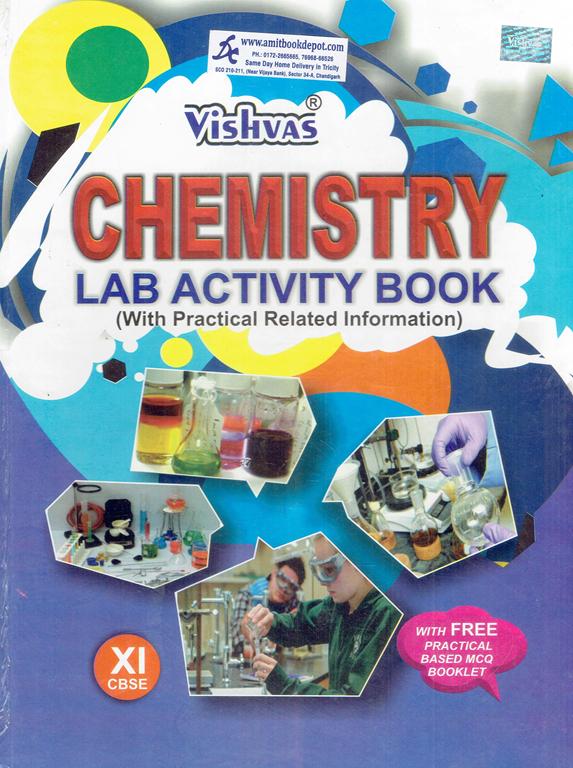
Vishvas Chemistry Lab Activity Book With Practical Related Information Class 11th by Sukhwinder Kaur offers complete CBSE practical exam preparation. This lab manual covers basic laboratory techniques, pH experiments, chemical equilibrium, quantitative estimation, and qualitative analysis of cations and anions. Includes step-by-step investigatory projects on evaporation, antacids, and fibre strength. Ideal for class 11 chemistry practicals, viva voce, and board exams. Published by Vishvas Publications Pvt. Ltd, the book ensures clarity with practical related information, melting/boiling point determination, and titration procedures. Essential for scoring full marks in chemistry lab assessments.




Use a triangular file to make a single deep scratch, then hold tube with both hands, thumbs on scratch, and apply gentle outward pressure to snap.
A 60-degree angle ensures smooth vapour flow without excessive condensation or breakage, unlike sharp 90-degree bends.
Select cork borer slightly smaller than tube diameter, lubricate, twist gently through cork, then insert glass tube carefully.
Universal indicator or pH paper shows HCl at pH ~1 (red) and acetic acid at pH ~3 (orange-yellow) due to weaker dissociation.
Oxalic acid is a stable, primary standard that does not absorb moisture, allowing accurate weighing and precise normality.
Prepare Lassaigne’s extract, add FeSO₄ and dilute H₂SO₄. Prussian blue colour confirms nitrogen.
Added H⁺ is consumed by acetate ions; added OH⁻ is neutralised by acetic acid. pH remains nearly constant.
Cu²⁺ (blue colour, turning deep blue with NH₃) and SO₄²⁻ (white precipitate with BaCl₂ insoluble in HCl).
In Lassaigne’s extract, add HNO₃ then AgNO₃ – yellow precipitate insoluble in NH₃ indicates iodine.
Commercial antacids with aluminium hydroxide and magnesium hydroxide typically neutralise more HCl than simple calcium carbonate tablets.
Use a triangular file to make a single deep scratch, then hold tube with both hands, thumbs on scratch, and apply gentle outward pressure to snap.
A 60-degree angle ensures smooth vapour flow without excessive condensation or breakage, unlike sharp 90-degree bends.
Select cork borer slightly smaller than tube diameter, lubricate, twist gently through cork, then insert glass tube carefully.
Universal indicator or pH paper shows HCl at pH ~1 (red) and acetic acid at pH ~3 (orange-yellow) due to weaker dissociation.
Oxalic acid is a stable, primary standard that does not absorb moisture, allowing accurate weighing and precise normality.
Prepare Lassaigne’s extract, add FeSO₄ and dilute H₂SO₄. Prussian blue colour confirms nitrogen.
Added H⁺ is consumed by acetate ions; added OH⁻ is neutralised by acetic acid. pH remains nearly constant.
Cu²⁺ (blue colour, turning deep blue with NH₃) and SO₄²⁻ (white precipitate with BaCl₂ insoluble in HCl).
In Lassaigne’s extract, add HNO₃ then AgNO₃ – yellow precipitate insoluble in NH₃ indicates iodine.
Commercial antacids with aluminium hydroxide and magnesium hydroxide typically neutralise more HCl than simple calcium carbonate tablets.