Categories
College Bookssss >
BA PU Chandigarh
BSC PU Chandigarh
MSC PU Chandigarh
BBA PU Chandigarh
MA PU Chandigarh
Medical Books
Engineering Books
Management Books
PGDCA Books
BCOM PU Chandigarh
MCOM PU Chandigarh
BCA PU Chandigarh
MCA PU Chandigarh
animate-books

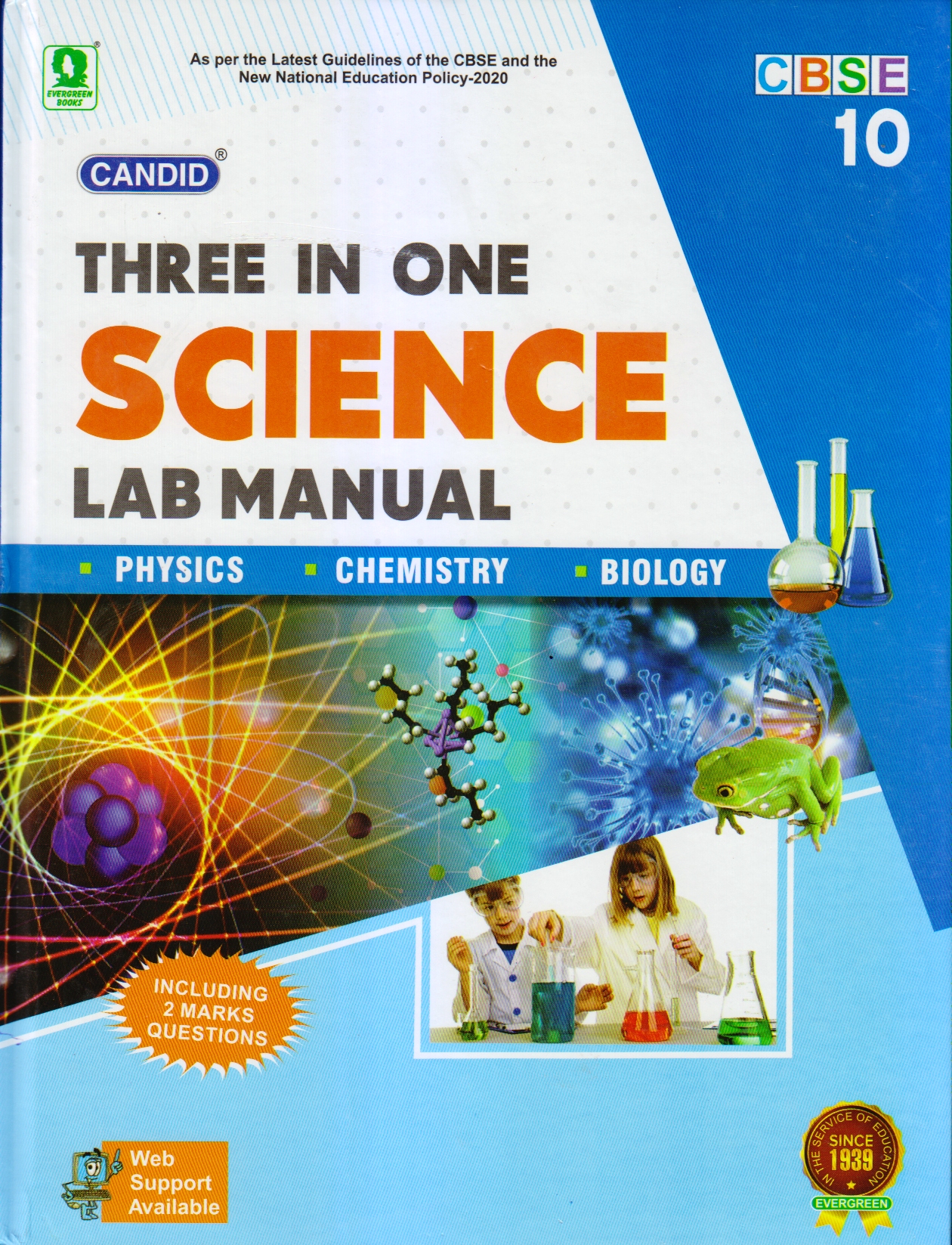
Three in One Science Lab Manual for Class 10th

by Madhurima
₹351 ₹390.00(-/ off)

Rating & Reviews

23 Customer Review

Evergreen Three in One Science Lab Manual for Class 10 by Stalin Malhotra, Jatinder Singh, and Pradeep Singh, published by Evergreen Publications (India) Ltd., is the ultimate practical guide for CBSE students. This single volume covers all essential physics, chemistry, and biology experiments – from verifying Ohm’s Law and calculating resistances in series & parallel to determining the focal length of a concave mirror and convex lens, studying refraction of light through a glass slab and prism, performing temporary mount preparation, analysing pH value and chemical reactions, testing the cleaning capacity of soap in hard and soft water, and observing binary fission, budding, respiration, and embryology. Includes a dedicated Practical-Based Questions chapter for exam practice. Ideal for scoring top marks in Class 10 science practicals.

Have Doubts Regarding This Product ? Ask Your Question

  • Q1
    What is the aim of the pH Value experiment?
    A1

    To determine the pH of various solutions using pH paper or universal indicator and classify them as acidic, basic, or neutral.

  • Q2
    How is the focal length of a concave mirror determined?
    A2

    By focusing a distant object (e.g., tree or window) on a screen and measuring the distance between mirror and sharp image.

  • Q3
    What changes are observed in an acid-base reaction using phenolphthalein?
    A3

    Phenolphthalein remains colorless in acid but turns pink when base is added, indicating neutralization endpoint.

  • Q4
    What is the relationship verified by Ohm’s Law?
    A4

    At constant temperature, current through a conductor is directly proportional to potential difference across it.

  • Q5
    How do you calculate total resistance in a series combination?
    A5

    Add individual resistances: Rs = R1 + R2 + R3. Total resistance increases and exceeds the largest resistor.

  • Q6
    How does refraction through a glass slab differ from a prism?
    A6

    Glass slab causes parallel lateral shift without deviation; prism causes angular deviation and dispersion of white light.

  • Q7
    What happens during refraction of light through a prism?
    A7

    Light splits into seven colors (VIBGYOR) due to different bending angles for different wavelengths of light.

  • Q8
    How is focal length of a convex lens measured?
    A8

    Form a sharp image of a distant object on a screen; distance between lens and screen equals approximate focal length.

  • Q9
    Why is potassium permanganate used in the respiration experiment?
    A9

    It tests CO2 release – germinating seeds produce CO2 that turns the pink permanganate solution colorless.

  • Q10
    What is observed in budding of yeast under microscope?
    A10

    Small bud (outgrowth) forms on parent cell, enlarges, and eventually separates to form a new daughter cell.


0.00

0 Overall Rating
  • 5
    0
  • 4
    0
  • 3
    0
  • 2
    0
  • 1
    0

Try this product & share your review & thoughts

1. pH Value
2. Acid-Base Reactions
3. Chemical Reactions
4. Metals and Their Properties
5. Electricity And Its Effects (Ohm’s Law)
6. (a) Resistances in Series
- (b) Resistances in Parallel
7. Temporary Mount Preparation
8. Respiration
9. Properties of Organic Acid
10. Cleaning Capacity of Soap in Hard and Soft Water
11. (a) Focal Length - I (Focal Length of a Concave Mirror)
- (b) Focal Length - II (Focal length of a convex lens)
12. Refraction of Light through Glass Slab
13. Binary Fission and Budding
14. Refraction of Light through a Prism
15. Embryology

- Practical-Based Questions

The Evergreen Three in One Science Lab Manual for Class 10 is a comprehensive, CBSE-aligned practical resource designed to bridge theoretical concepts with hands-on experimentation. Authored by renowned educators Stalin Malhotra, Jatinder Singh, and Pradeep Singh, this manual integrates physics, chemistry, and biology experiments into a single, streamlined volume. Published by Evergreen Publications (India) Ltd., it serves as an indispensable tool for students aiming to excel in practical examinations and build a strong foundation for higher studies.

This lab manual systematically covers all major experiments prescribed for Class 10 science. In chemistry, students explore foundational topics such as pH value (testing acids, bases, and salts); acid-base reactions; various chemical reactions (combination, decomposition, and displacement); properties of organic acids; comparative cleaning capacity of soap in hard and soft water; and metals and their properties. Each experiment includes detailed observation tables and viva-voce questions, reinforcing conceptual clarity.

In physics, the manual provides rigors coverage of electricity and its effects through Ohm’s Law verification and calculations of resistances in series and resistances in parallel. Optics experiments are explained step-by-step, including determination of focal length of a concave mirror and focal length of a convex lens (listed as Focal Length - I and II), study of refraction of light through a glass slab, and dispersion using refraction of light through a prism. Each derivation is accompanied by circuit diagrams, ray diagrams, and common error-prevention tips.

The Biology section emphasises microscope work and slide preparation. Key experiments include temporary mount preparation (onion peel, cheek cells), study of respiration in germinating seeds, observation of binary fission and budding in yeast or hydra, and an introduction to embryology through charts or models. The manual also includes a dedicated chapter on practical-based questions—a crucial feature for mastering assertion-reason, diagram-based, and observation-based problems frequently asked in board practical exams.

Each experiment follows a uniform, exam-friendly layout: Aim, Materials Required, Theory, Procedure, Observations, Calculations, Results, Precautions, and Viva Voce. The Practical-Based Questions section at the end consolidates high-order thinking questions, helping students apply their knowledge beyond rote learning.

Key Features:

- Three-in-One integration – Covers all three science streams in one manual.
- Latest CBSE syllabus compliance – Updated content as per Class 10 guidelines.
- Diagrammatic clarity – Neat, labelled diagrams for mirror/lens setups, electrical circuits, and biological slides.
- Error-free observations – Standardised readings for Ohm’s law, pH tests, and focal length calculations.
- Exam-oriented – Includes previous years’ practical-based questions with answer keys.

This lab manual is ideal for self-study, last-minute revision before practical exams, and as a teacher’s reference for classroom demonstrations. Its durable paperback binding and clear typesetting make it a practical choice for daily lab use. Available exclusively through Evergreen Publications (India) Ltd., it is a must-have for every Class 10 student seeking to secure full marks in their science practical assessments.

1. pH Value
2. Acid-Base Reactions
3. Chemical Reactions
4. Metals and Their Properties
5. Electricity And Its Effects (Ohm’s Law)
6. (a) Resistances in Series
- (b) Resistances in Parallel
7. Temporary Mount Preparation
8. Respiration
9. Properties of Organic Acid
10. Cleaning Capacity of Soap in Hard and Soft Water
11. (a) Focal Length - I (Focal Length of a Concave Mirror)
- (b) Focal Length - II (Focal length of a convex lens)
12. Refraction of Light through Glass Slab
13. Binary Fission and Budding
14. Refraction of Light through a Prism
15. Embryology

- Practical-Based Questions

Have Doubts Regarding This Product ? Ask Your Question

  • Q1
    What is the aim of the pH Value experiment?
    A1

    To determine the pH of various solutions using pH paper or universal indicator and classify them as acidic, basic, or neutral.

  • Q2
    How is the focal length of a concave mirror determined?
    A2

    By focusing a distant object (e.g., tree or window) on a screen and measuring the distance between mirror and sharp image.

  • Q3
    What changes are observed in an acid-base reaction using phenolphthalein?
    A3

    Phenolphthalein remains colorless in acid but turns pink when base is added, indicating neutralization endpoint.

  • Q4
    What is the relationship verified by Ohm’s Law?
    A4

    At constant temperature, current through a conductor is directly proportional to potential difference across it.

  • Q5
    How do you calculate total resistance in a series combination?
    A5

    Add individual resistances: Rs = R1 + R2 + R3. Total resistance increases and exceeds the largest resistor.

  • Q6
    How does refraction through a glass slab differ from a prism?
    A6

    Glass slab causes parallel lateral shift without deviation; prism causes angular deviation and dispersion of white light.

  • Q7
    What happens during refraction of light through a prism?
    A7

    Light splits into seven colors (VIBGYOR) due to different bending angles for different wavelengths of light.

  • Q8
    How is focal length of a convex lens measured?
    A8

    Form a sharp image of a distant object on a screen; distance between lens and screen equals approximate focal length.

  • Q9
    Why is potassium permanganate used in the respiration experiment?
    A9

    It tests CO2 release – germinating seeds produce CO2 that turns the pink permanganate solution colorless.

  • Q10
    What is observed in budding of yeast under microscope?
    A10

    Small bud (outgrowth) forms on parent cell, enlarges, and eventually separates to form a new daughter cell.

No Syllabus Added

0.00

0 Overall Rating
  • 5
    0
  • 4
    0
  • 3
    0
  • 2
    0
  • 1
    0

Try this product & share your review & thoughts

Top Trending Product

Related Product

Related Product

Related Blog Posts

Latest Blogs

Latest Blogs

blog-img
Classic Literature Reimagined: Discuss modern twists on classic novels.
Lorem ipsum dolor sit amet, consectetur adipiscing elit, sed do eiusmod tempor incididunt ut labore et dolore magna aliqua. Ut enim ad minim veniam, quis nostrud exercitation ullamco Lorem ipsum dolor sit amet, consectetur adipiscing elit, sed do eiusmod tempor incididunt ut labore et dolore magna aliqua. Utenim ad minim veniam, quis nostrud exercitation ullamco Lorem ipsum dolor sit amet, consecte...
Read more
Author name | 10 jan, 2025
blog-img
Classic Literature Reimagined: Discuss modern twists on classic novels.
Lorem ipsum dolor sit amet, consectetur adipiscing elit, sed do eiusmod tempor incididunt ut labore et dolore magna aliqua. Ut enim ad minim veniam, quis nostrud exercitation ullamco Lorem ipsum dolor sit amet, consectetur adipiscing elit, sed do eiusmod tempor incididunt ut labore et dolore magna aliqua. Utenim ad minim veniam, quis nostrud exercitation ullamco Lorem ipsum dolor sit amet, consecte...
Read more
Author name | 10 jan, 2025
blog-img
Classic Literature Reimagined: Discuss modern twists on classic novels.
Lorem ipsum dolor sit amet, consectetur adipiscing elit, sed do eiusmod tempor incididunt ut labore et dolore magna aliqua. Ut enim ad minim veniam, quis nostrud exercitation ullamco Lorem ipsum dolor sit amet, consectetur adipiscing elit, sed do eiusmod tempor incididunt ut labore et dolore magna aliqua. Utenim ad minim veniam, quis nostrud exercitation ullamco Lorem ipsum dolor sit amet, consecte...
Read more
Author name | 10 jan, 2025
blog-img
Classic Literature Reimagined: Discuss modern twists on classic novels.
Lorem ipsum dolor sit amet, consectetur adipiscing elit...
Read more
Author Name | 10 Jan, 2025
blog-img
Classic Literature Reimagined: Discuss modern twists on classic novels.
Lorem ipsum dolor sit amet, consectetur adipiscing elit...
Read more
Author Name | 10 Jan, 2025
blog-img
Classic Literature Reimagined: Discuss modern twists on classic novels.
Lorem ipsum dolor sit amet, consectetur adipiscing elit...
Read more
Author Name | 10 Jan, 2025
blog-img
Classic Literature Reimagined: Discuss modern twists on classic novels.
Lorem ipsum dolor sit amet, consectetur adipiscing elit...
Read more
Author Name | 10 Jan, 2025
blog-img
Classic Literature Reimagined: Discuss modern twists on classic novels.
Lorem ipsum dolor sit amet, consectetur adipiscing elit...
Read more
Author Name | 10 Jan, 2025
blog-img
Classic Literature Reimagined: Discuss modern twists on classic novels.
Lorem ipsum dolor sit amet, consectetur adipiscing elit...
Read more
Author Name | 10 Jan, 2025
blog-img
Classic Literature Reimagined: Discuss modern twists on classic novels.
Lorem ipsum dolor sit amet, consectetur adipiscing elit...
Read more
Author Name | 10 Jan, 2025
blog-img
Classic Literature Reimagined: Discuss modern twists on classic novels.
Lorem ipsum dolor sit amet, consectetur adipiscing elit...
Read more
Author Name | 10 Jan, 2025
blog-img
Classic Literature Reimagined: Discuss modern twists on classic novels.
Lorem ipsum dolor sit amet, consectetur adipiscing elit...
Read more
Author Name | 10 Jan, 2025