-
Mon-Fri: 10AM to 8PM 01722665665
-
My Account
-
-
0
Total :
₹ 0.00

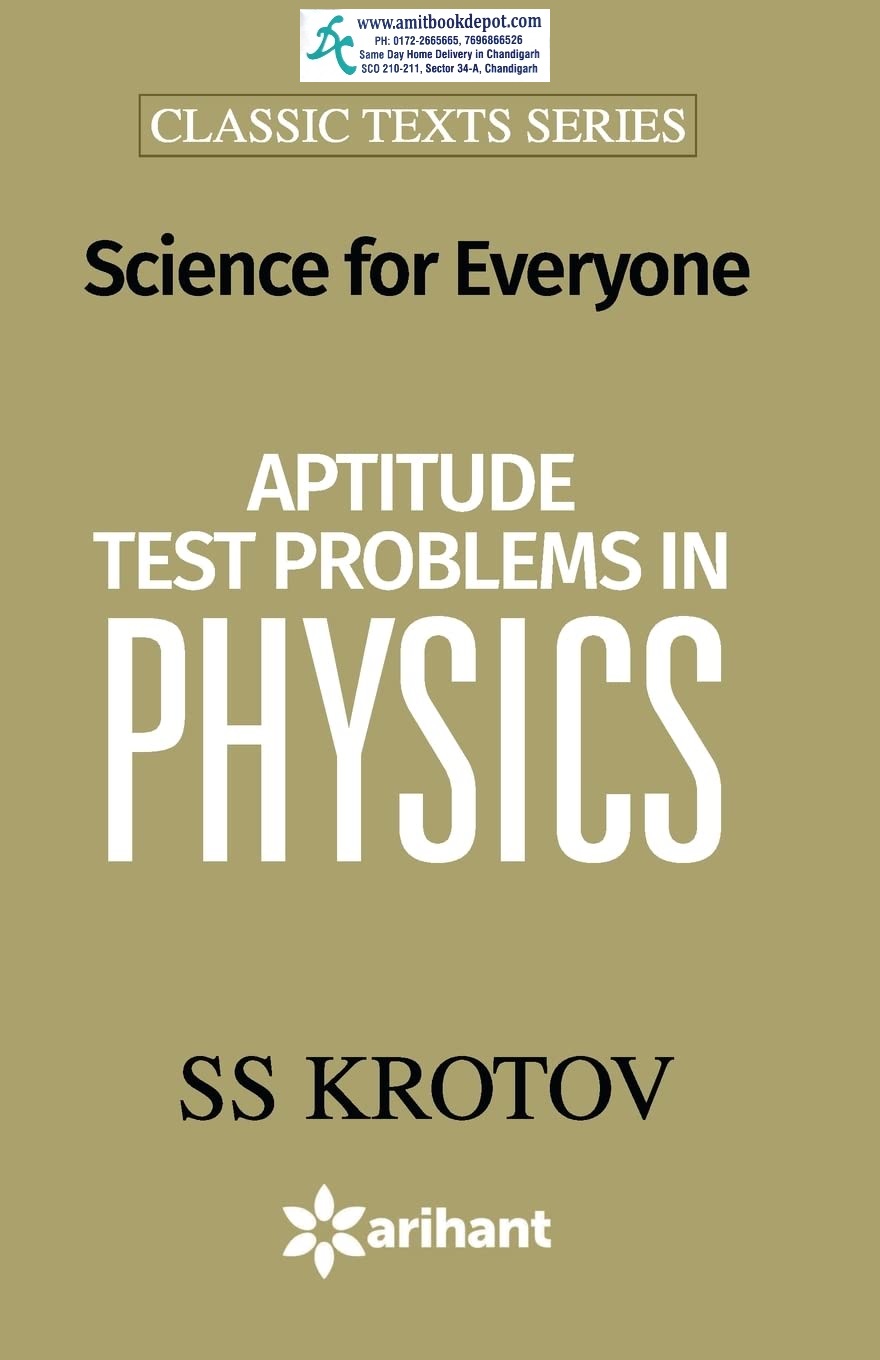
Master physics problem-solving with S. S. Krotov’s classic text, now published by Arihant Prakashan. Ideal for Olympiad, IIT JEE, and competitive exam aspirants, this book offers high-level aptitude test problems across mechanics, heat & molecular physics, electricity & magnetism, and optics. Each section includes detailed solutions, helping students develop conceptual clarity and analytical reasoning. Designed for science everyone can benefit from, this rigors problem collection bridges foundational theory and advanced application. Boost your exam performance and build confidence for the toughest physics aptitude tests.
Focuses on process-driven learning. Descriptive problems build deeper analytical skills, unlike guessable MCQs. Solutions train step-by-step reasoning for real aptitude tests.
Not recommended. Learners should first understand basic theory from NCERT or Halliday/Resnick. Krotov is for intermediate/advanced aptitude test practice.
Yes. Mechanics section includes dimensional checks and unit conversion problems, essential for verifying equations in physics aptitude tests.
Yes. Blackbody radiation, Stefan’s law, and Wien’s displacement are featured as aptitude problems with numerical and conceptual variants.
Krotov uses symmetric networks, infinite ladder circuits, and non-ideal meters — problems rarely seen in school exams but common in Olympiads.
Yes. Interference, diffraction, and polarization appear alongside geometric optics. Solutions emphasize phase difference and path difference calculations.
Yes. Rocket motion, falling chains, and conveyor belt problems test momentum conservation with changing mass — a key aptitude concept.
Solutions often include “Note” or “Reason” sections clarifying logical jumps, symmetry arguments, and approximations used in the problem.
Highly useful. Though slightly advanced, NEET aspirants can solve selected moderate problems to improve speed and concept application.
Many problems are adapted from Soviet and Russian Olympiads, making this a unique exposure to international physics aptitude standards.
Focuses on process-driven learning. Descriptive problems build deeper analytical skills, unlike guessable MCQs. Solutions train step-by-step reasoning for real aptitude tests.
Not recommended. Learners should first understand basic theory from NCERT or Halliday/Resnick. Krotov is for intermediate/advanced aptitude test practice.
Yes. Mechanics section includes dimensional checks and unit conversion problems, essential for verifying equations in physics aptitude tests.
Yes. Blackbody radiation, Stefan’s law, and Wien’s displacement are featured as aptitude problems with numerical and conceptual variants.
Krotov uses symmetric networks, infinite ladder circuits, and non-ideal meters — problems rarely seen in school exams but common in Olympiads.
Yes. Interference, diffraction, and polarization appear alongside geometric optics. Solutions emphasize phase difference and path difference calculations.
Yes. Rocket motion, falling chains, and conveyor belt problems test momentum conservation with changing mass — a key aptitude concept.
Solutions often include “Note” or “Reason” sections clarifying logical jumps, symmetry arguments, and approximations used in the problem.
Highly useful. Though slightly advanced, NEET aspirants can solve selected moderate problems to improve speed and concept application.
Many problems are adapted from Soviet and Russian Olympiads, making this a unique exposure to international physics aptitude standards.