-
Mon-Fri: 10AM to 8PM 01722665665
-
My Account
-
-
0
Total :
₹ 0.00

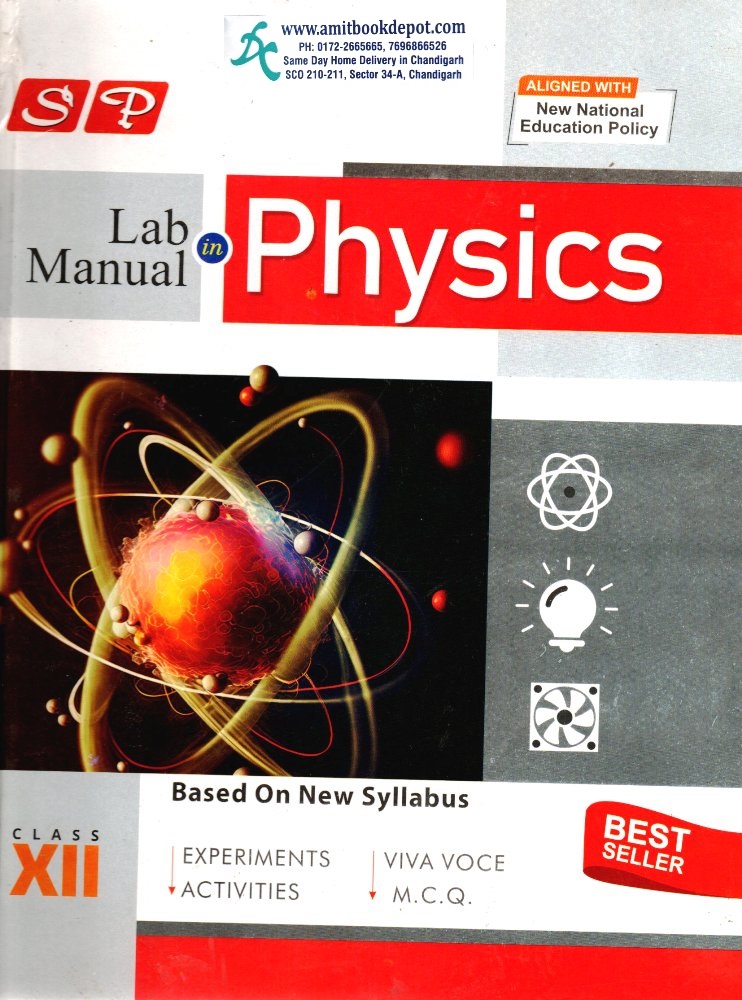
SP Physics Laboratory Manual and Practical Record Book for Class 12E by SP Books is a complete, syllabus-aligned guide for CBSE Class 12 Physics practical exams. This combined lab manual and record book covers all experiments from Section A (Current Electricity) and Section B (Optics & Modern Physics). Learn to determine resistivity using a V-I graph, verify metre bridge laws, convert a galvanometer into a voltmeter or ammeter, and find the frequency of A.C. mains with a sonometer. Master optics experiments, including finding focal lengths of concave/convex mirrors and lenses, determining the angle of minimum deviation of a prism, and plotting I-V characteristic curves of a p-n junction diode.





Yes. Experiment 4 covers the half-deflection method to find galvanometer resistance and figure of merit. Experiments 5(i) and 5(ii) cover conversion to voltmeter and ammeter.
Yes. Experiment 5 in Section B provides detailed steps to plot the angle of incidence vs. angle of deviation graph to determine the angle of minimum deviation.
Yes. Activity 2 in Section A covers measuring resistance, AC/DC voltage, and current. Activity 2 in Section B checks unidirectional flow in diodes.
Yes. It is designed as a combined record book with dedicated blank spaces for observation tables, calculations, graphs, and results for each experiment.
Yes. Experiment 6 in Section A explains using a sonometer to find the frequency of A.C. mains step by step.
Yes. Experiment 9 in Section B provides complete procedure, circuit diagram, and observation table for forward and reverse bias characteristics of a p-n junction diode.
Yes. Each experiment ends with a set of viva voce questions and answers to help you prepare for the oral practical exam.
Yes. Experiment 7 in Section B describes the method using a convex lens and a plane mirror to determine the refractive index of a liquid.
Yes. Experiment 3(i) verifies series combination and Experiment 3(ii) verifies parallel combination of resistances using a metre bridge.
Yes. Experiment 6 in Section B provides the procedure to determine the refractive index of a glass slab using a travelling microscope.
Yes. Experiment 4 covers the half-deflection method to find galvanometer resistance and figure of merit. Experiments 5(i) and 5(ii) cover conversion to voltmeter and ammeter.
Yes. Experiment 5 in Section B provides detailed steps to plot the angle of incidence vs. angle of deviation graph to determine the angle of minimum deviation.
Yes. Activity 2 in Section A covers measuring resistance, AC/DC voltage, and current. Activity 2 in Section B checks unidirectional flow in diodes.
Yes. It is designed as a combined record book with dedicated blank spaces for observation tables, calculations, graphs, and results for each experiment.
Yes. Experiment 6 in Section A explains using a sonometer to find the frequency of A.C. mains step by step.
Yes. Experiment 9 in Section B provides complete procedure, circuit diagram, and observation table for forward and reverse bias characteristics of a p-n junction diode.
Yes. Each experiment ends with a set of viva voce questions and answers to help you prepare for the oral practical exam.
Yes. Experiment 7 in Section B describes the method using a convex lens and a plane mirror to determine the refractive index of a liquid.
Yes. Experiment 3(i) verifies series combination and Experiment 3(ii) verifies parallel combination of resistances using a metre bridge.
Yes. Experiment 6 in Section B provides the procedure to determine the refractive index of a glass slab using a travelling microscope.