-
Mon-Fri: 10AM to 8PM 01722665665
-
My Account
-
-
0
Total :
₹ 0.00

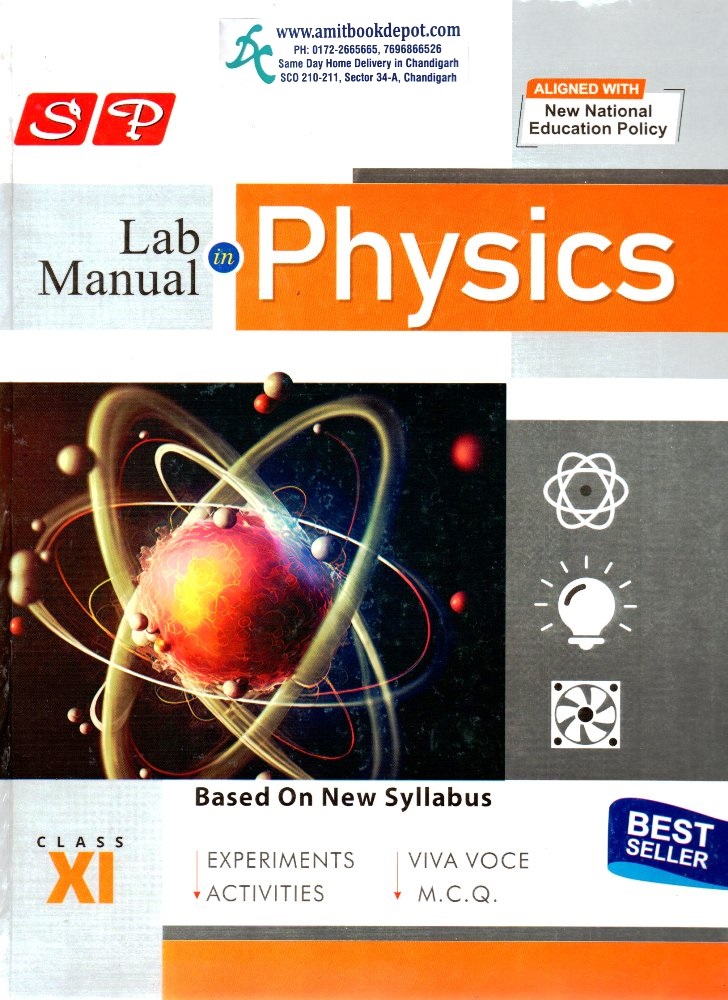
The SP Laboratory Manual Physics for Class 11 is a comprehensive, CBSE-aligned practical book designed to bridge theoretical concepts with hands-on experimentation. Published by SP Books, this manual covers all core experiments and activities as per the latest Class 11 syllabus. It includes detailed procedures for using Vernier callipers, screw gauges, spherometers, and sonometers, along with viva voce preparation through multiple-choice questions. The manual emphasises graphical analysis, error plotting, and real-world applications such as determining Young’s modulus, coefficient of viscosity, and surface tension of water. With dedicated sections on cooling curves, the law of vectors, and simple pendulum variations, this book is an essential tool for students aiming to master physics practicals, improve lab performance, and excel in examinations.




Experiments include measuring diameter of a spherical body, internal diameter of a beaker, and calculating volume of a calorimeter.
Yes. It guides plotting L-T and L-T² graphs to find the effective length of a second’s pendulum.
Yes. Experiment 3 determines the volume of an irregular lamina using a screw gauge.
Section B, Experiment 1: To determine Young’s modulus of elasticity of the material of a given wire.
Experiment 6 in Section A uses the parallelogram law to find the weight of a given body.
Yes. Section B, Experiment 4 determines surface tension of water by the capillary rise method.
Yes. Experiment 5 determines coefficient of viscosity using terminal velocity of a spherical body.
Yes. Experiment 7 determines specific heat capacity of a solid using the method of mixtures.
Yes. Section B Activity 7 observes decrease in pressure with increase in fluid velocity.
Yes. Section B Activity 4 studies detergent’s effect on surface tension via capillary rise observation.
Experiments include measuring diameter of a spherical body, internal diameter of a beaker, and calculating volume of a calorimeter.
Yes. It guides plotting L-T and L-T² graphs to find the effective length of a second’s pendulum.
Yes. Experiment 3 determines the volume of an irregular lamina using a screw gauge.
Section B, Experiment 1: To determine Young’s modulus of elasticity of the material of a given wire.
Experiment 6 in Section A uses the parallelogram law to find the weight of a given body.
Yes. Section B, Experiment 4 determines surface tension of water by the capillary rise method.
Yes. Experiment 5 determines coefficient of viscosity using terminal velocity of a spherical body.
Yes. Experiment 7 determines specific heat capacity of a solid using the method of mixtures.
Yes. Section B Activity 7 observes decrease in pressure with increase in fluid velocity.
Yes. Section B Activity 4 studies detergent’s effect on surface tension via capillary rise observation.