Categories
College Bookssss >
BA PU Chandigarh
BSC PU Chandigarh
MSC PU Chandigarh
BBA PU Chandigarh
MA PU Chandigarh
Medical Books
Engineering Books
Management Books
PGDCA Books
BCOM PU Chandigarh
MCOM PU Chandigarh
BCA PU Chandigarh
MCA PU Chandigarh
animate-books

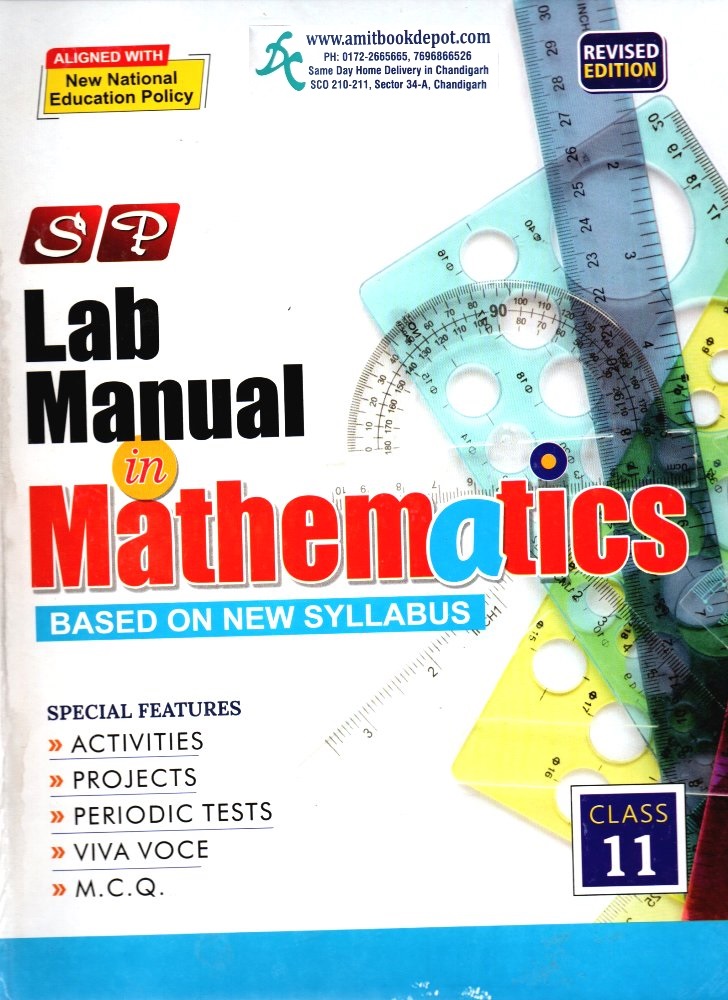
SP Laboratory Manual Mathematics for Class 11th

by Madhurima
₹425 ₹425.00(-/ off)

Rating & Reviews

23 Customer Review

The SP Laboratory Manual Mathematics for Class 11 by SP Books is a complete activity-based guide for CBSE and state board students. This manual transforms theoretical Class 11 mathematics into practical, verifiable experiments. It covers 33 engaging activities, including verifying the number of subsets formula (2ⁿ), distinguishing between relations and functions, plotting sin x and sin 2x graphs, constructing Pascal’s triangle for binomial expansion, building ellipse and parabola models, verifying AM > GM, deriving the sum of squares of the first n natural numbers, and writing sample spaces for dice and coin tosses. Advanced activities include geometrical significance of derivatives and truth values using switch connections (series/parallel).
Have Doubts Regarding This Product ? Ask Your Question

  • Q1
    What formula is verified in Activity 1 of the SP Class 11 Maths Lab Manual?
    A1

    The formula verified is 2ⁿ, where n is the number of elements in a set, giving the total number of subsets.

  • Q2
    How does the manual help distinguish between a relation and a function?
    A2

    Activities 5 and 6 provide step-by-step comparisons using ordered pairs, helping students identify one-to-one and many-to-one mappings.

  • Q3
    What trigonometric graphs are plotted on the same axes in Activity 10?
    A3

    Graphs of sin x, sin 2x, and 2 sin x are plotted together to compare amplitude and period.

  • Q4
    How does the manual verify AM > GM?
    A4

    Activity 18 demonstrates using two different positive numbers that arithmetic mean is always greater than geometric mean.

  • Q5
    Which activity finds the sum of squares formula for first n natural numbers?
    A5

    Activity 16 directly obtains the formula, while Activity 17 provides an alternative approach.

  • Q6
    How is Pascal's Triangle used in this manual?
    A6

    Activity 15 constructs Pascal's Triangle to write binomial expansion for any given positive integral exponent.

  • Q7
    What does Activity 13 verify about linear inequalities?
    A7

    It verifies that graph of 5x+4y<400 represents only one of two half-planes.

  • Q8
    How is derivative's geometrical significance verified?
    A8

    Activity 29 uses a curve and tangent to verify that derivative equals slope of tangent at a point.

  • Q9
    Which activity interprets the geometric meaning of i = √-1?
    A9

    Activity 11 interprets i and its integral powers geometrically on the complex plane.

  • Q10
    How does the manual construct a parabola alternatively?
    A10

    Activity 23 provides an alternative method using a fixed point (focus) and a fixed line (directrix).
0.00

0 Overall Rating
  • 5
    0
  • 4
    0
  • 3
    0
  • 2
    0
  • 1
    0

Try this product & share your review & thoughts

ACTIVITIES

1. To find the number of subsets of a given set and verify that if a set has a number of elements, then the total number of subsets is 2ⁿ."
2. To verify that for two sets A and B, n (AxB) = pq and the total number of relations from A to B is 2P, where n(A) = p and n(B) = q.
3. To represent set theoretic operations using Venn diagrams.
4. To verify the distributive law for three given non-empty sets A, B and C, that is, AU (B ∩ C)=(AUB) ∩ (AUC)
5. To identify a relation and a function.
6. To distinguish between a relation and a function.
7. To verify the relation between the degree measure and the radian measure of an angle.
8. To find the values of sine and cosine functions in the second, third and fourth quadrants using their given values in the first quadrant.
9. To prepare a model to illustrate the values of the sine function and cosine function for different angles which are multiples of and π.
10. To plot the graphs of sin x, sin 2x, 2 sin x and sin using the same coordinate axes.
11. To interpret geometrically the meaning of i = 1 and its integral powers.
12. To obtain a quadratic function with the help of linear functions graphically.
13. To verify that the graph of a given inequality, say 5x + 4y < 400, of the form axe + by + c < 0, a, b > 0, c < 0, represents only one of the two half-planes.
14. To find the number of ways in which three cards can be selected from five given cards.
15. To construct Pascal's Triangle and to write the binomial expansion for a given positive integral exponent.
16. To obtain a formula for the sum of squares of the first n natural numbers.
17. An alternative approach to obtain a formula for the sum of squares of the first n natural numbers.
18. To demonstrate that the arithmetic mean of two different positive numbers is always greater than the geometric mean.
19. To establish the formula for the sum of the cubes of the first 1 natural numbers.
20. To verify that the equation of a line passing through the point of intersection of two lines ax+by+q=0 and ax+by+c2=0 is of the form (ax+by+c)+2(ax+by+c2)=0.
21. To construct different types of conic sections.
22. To construct a parabola.
23. An alternative method of constructing a parabola.
24. To construct an ellipse using a rectangle.
25. To construct an ellipse with given major and minor axes.
26. To construct an ellipse when two fixed points are given.
27. To explain the concept of octants by three mutually perpendicular planes in space.
28. To find analytically lim f(x) = x - c
29. Verification of the geometrical significance of the derivative.
30. To obtain truth values of compound statements of the type 'pvq' by using switch connections in parallel.
31. To obtain truth values of compound statements of the type 'pq' by using switch connections in series.
32. To write the sample space when a die is rolled once, twice,
33. To write the sample space when a coin is tossed once, two times, three times, or four times.

- Periodic Test
- Multiple Choice Questions

The SP Laboratory Manual Mathematics for Class 11 is a comprehensive, activity-based learning resource designed strictly in accordance with the latest CBSE and other state board curriculum requirements. Published by SP Books, this manual bridges the gap between theoretical mathematical concepts and practical application, enabling students to visualise, verify, and internalise key ideas from Class 11 Mathematics through hands-on activities.

This laboratory manual is not merely a collection of exercises; it is a structured pedagogical tool that transforms abstract formulas into tangible learning experiences. Each activity is crafted with clear objectives, step-by-step procedures, observation tables, and conclusion-based questions, ensuring that students develop a deep and intuitive understanding of the subject. The primary keywords associated with this manual include CBSE Class 11 Maths lab manual, hands-on mathematics activities, Venn diagrams verification, relations and functions distinction, trigonometric function graphs, Pascal’s triangle, binomial expansion, conic sections construction, ellipse and parabola drawing, limits and derivatives geometrical significance, sample space in probability, truth values using switch connections, and sum of squares and cubes of natural numbers.

Key Features & Syllabus Coverage:

The manual covers 33 core activities that systematically address the major pillars of Class 11 mathematics.

1. Sets and Functions: Foundational activities guide students to find the number of subsets of a given set and verify the formula 2ⁿ. Students will verify the distributive law for union and intersection (AU (B ∩ C) = (AUB) ∩ (AUC)) using Venn diagrams. The critical skill to distinguish between a relation and a function is reinforced through dedicated experiments.
2. Trigonometry: Practical models help students verify the relation between degree and radian measure and find values of sine and cosine functions across all quadrants. A key activity involves plotting graphs of sin x, sin 2x, and 2 sin x on the same coordinate axes to understand amplitude and period changes.
3. Algebra & Number Theory: Learners construct Pascal’s triangle to write binomial expansion for any positive integer exponent. Alternative approaches are provided to obtain a formula for the sum of squares and the sum of cubes of the first n natural numbers. The manual also demonstrates that the arithmetic mean (AM) of two different positive numbers is always greater than the geometric mean (GM).
4. Coordinate Geometry: Students verify the equation of a line passing through the intersection of two lines. Multiple methods are presented to construct a parabola (standard and alternative); construct an ellipse using a rectangle with given major/minor axes or two fixed points; and even construct different types of conic sections (circle, ellipse, parabola, and hyperbola).
5. Calculus (Introduction): An analytical activity guides students to find the limit of a function as x approaches c, followed by a verification of the geometrical significance of the derivative (slope of tangent).
6. Mathematical Reasoning & Probability: Using real-world switch connections in series and parallel, students obtain truth values of compound statements (pvq and p^q). Extensive sample space writing tasks include sample space when a die is rolled once or twice, and when a coin is tossed once, twice, thrice, or four times.

Assessment Tools:

To ensure exam readiness, the manual includes a periodic test and a bank of multiple-choice questions (MCQs). These assessment sections are designed to test both procedural knowledge and conceptual clarity gained through the activities.

Why Choose This Manual?

- Activity-to-Concept Mapping: Every activity is linked directly to NCERT book chapters.
- Visual & Kinesthetic Learning: Construction of geometric figures (ellipse, parabola, and conics) builds spatial intelligence.
- Error-Free Content: Verified procedures and expected outcomes by subject experts from SP Books.
- Classroom & Home Use: Clear instructions make it suitable for both school lab work and self-practice.

This SP Laboratory Manual Mathematics for Class 11 is an indispensable companion for any Class 11 student aiming to master mathematics through verification, discovery, and application rather than rote memorisation.

ACTIVITIES

1. To find the number of subsets of a given set and verify that if a set has a number of elements, then the total number of subsets is 2ⁿ."
2. To verify that for two sets A and B, n (AxB) = pq and the total number of relations from A to B is 2P, where n(A) = p and n(B) = q.
3. To represent set theoretic operations using Venn diagrams.
4. To verify the distributive law for three given non-empty sets A, B and C, that is, AU (B ∩ C)=(AUB) ∩ (AUC)
5. To identify a relation and a function.
6. To distinguish between a relation and a function.
7. To verify the relation between the degree measure and the radian measure of an angle.
8. To find the values of sine and cosine functions in the second, third and fourth quadrants using their given values in the first quadrant.
9. To prepare a model to illustrate the values of the sine function and cosine function for different angles which are multiples of and π.
10. To plot the graphs of sin x, sin 2x, 2 sin x and sin using the same coordinate axes.
11. To interpret geometrically the meaning of i = 1 and its integral powers.
12. To obtain a quadratic function with the help of linear functions graphically.
13. To verify that the graph of a given inequality, say 5x + 4y < 400, of the form axe + by + c < 0, a, b > 0, c < 0, represents only one of the two half-planes.
14. To find the number of ways in which three cards can be selected from five given cards.
15. To construct Pascal's Triangle and to write the binomial expansion for a given positive integral exponent.
16. To obtain a formula for the sum of squares of the first n natural numbers.
17. An alternative approach to obtain a formula for the sum of squares of the first n natural numbers.
18. To demonstrate that the arithmetic mean of two different positive numbers is always greater than the geometric mean.
19. To establish the formula for the sum of the cubes of the first 1 natural numbers.
20. To verify that the equation of a line passing through the point of intersection of two lines ax+by+q=0 and ax+by+c2=0 is of the form (ax+by+c)+2(ax+by+c2)=0.
21. To construct different types of conic sections.
22. To construct a parabola.
23. An alternative method of constructing a parabola.
24. To construct an ellipse using a rectangle.
25. To construct an ellipse with given major and minor axes.
26. To construct an ellipse when two fixed points are given.
27. To explain the concept of octants by three mutually perpendicular planes in space.
28. To find analytically lim f(x) = x - c
29. Verification of the geometrical significance of the derivative.
30. To obtain truth values of compound statements of the type 'pvq' by using switch connections in parallel.
31. To obtain truth values of compound statements of the type 'pq' by using switch connections in series.
32. To write the sample space when a die is rolled once, twice,
33. To write the sample space when a coin is tossed once, two times, three times, or four times.

- Periodic Test
- Multiple Choice Questions

Have Doubts Regarding This Product ? Ask Your Question

  • Q1
    What formula is verified in Activity 1 of the SP Class 11 Maths Lab Manual?
    A1

    The formula verified is 2ⁿ, where n is the number of elements in a set, giving the total number of subsets.

  • Q2
    How does the manual help distinguish between a relation and a function?
    A2

    Activities 5 and 6 provide step-by-step comparisons using ordered pairs, helping students identify one-to-one and many-to-one mappings.

  • Q3
    What trigonometric graphs are plotted on the same axes in Activity 10?
    A3

    Graphs of sin x, sin 2x, and 2 sin x are plotted together to compare amplitude and period.

  • Q4
    How does the manual verify AM > GM?
    A4

    Activity 18 demonstrates using two different positive numbers that arithmetic mean is always greater than geometric mean.

  • Q5
    Which activity finds the sum of squares formula for first n natural numbers?
    A5

    Activity 16 directly obtains the formula, while Activity 17 provides an alternative approach.

  • Q6
    How is Pascal's Triangle used in this manual?
    A6

    Activity 15 constructs Pascal's Triangle to write binomial expansion for any given positive integral exponent.

  • Q7
    What does Activity 13 verify about linear inequalities?
    A7

    It verifies that graph of 5x+4y<400 represents only one of two half-planes.

  • Q8
    How is derivative's geometrical significance verified?
    A8

    Activity 29 uses a curve and tangent to verify that derivative equals slope of tangent at a point.

  • Q9
    Which activity interprets the geometric meaning of i = √-1?
    A9

    Activity 11 interprets i and its integral powers geometrically on the complex plane.

  • Q10
    How does the manual construct a parabola alternatively?
    A10

    Activity 23 provides an alternative method using a fixed point (focus) and a fixed line (directrix).

No Syllabus Added

0.00

0 Overall Rating
  • 5
    0
  • 4
    0
  • 3
    0
  • 2
    0
  • 1
    0

Try this product & share your review & thoughts

Top Trending Product

Related Product

Related Product

Related Blog Posts

Latest Blogs

Latest Blogs

blog-img
Classic Literature Reimagined: Discuss modern twists on classic novels.
Lorem ipsum dolor sit amet, consectetur adipiscing elit, sed do eiusmod tempor incididunt ut labore et dolore magna aliqua. Ut enim ad minim veniam, quis nostrud exercitation ullamco Lorem ipsum dolor sit amet, consectetur adipiscing elit, sed do eiusmod tempor incididunt ut labore et dolore magna aliqua. Utenim ad minim veniam, quis nostrud exercitation ullamco Lorem ipsum dolor sit amet, consecte...
Read more
Author name | 10 jan, 2025
blog-img
Classic Literature Reimagined: Discuss modern twists on classic novels.
Lorem ipsum dolor sit amet, consectetur adipiscing elit, sed do eiusmod tempor incididunt ut labore et dolore magna aliqua. Ut enim ad minim veniam, quis nostrud exercitation ullamco Lorem ipsum dolor sit amet, consectetur adipiscing elit, sed do eiusmod tempor incididunt ut labore et dolore magna aliqua. Utenim ad minim veniam, quis nostrud exercitation ullamco Lorem ipsum dolor sit amet, consecte...
Read more
Author name | 10 jan, 2025
blog-img
Classic Literature Reimagined: Discuss modern twists on classic novels.
Lorem ipsum dolor sit amet, consectetur adipiscing elit, sed do eiusmod tempor incididunt ut labore et dolore magna aliqua. Ut enim ad minim veniam, quis nostrud exercitation ullamco Lorem ipsum dolor sit amet, consectetur adipiscing elit, sed do eiusmod tempor incididunt ut labore et dolore magna aliqua. Utenim ad minim veniam, quis nostrud exercitation ullamco Lorem ipsum dolor sit amet, consecte...
Read more
Author name | 10 jan, 2025
blog-img
Classic Literature Reimagined: Discuss modern twists on classic novels.
Lorem ipsum dolor sit amet, consectetur adipiscing elit...
Read more
Author Name | 10 Jan, 2025
blog-img
Classic Literature Reimagined: Discuss modern twists on classic novels.
Lorem ipsum dolor sit amet, consectetur adipiscing elit...
Read more
Author Name | 10 Jan, 2025
blog-img
Classic Literature Reimagined: Discuss modern twists on classic novels.
Lorem ipsum dolor sit amet, consectetur adipiscing elit...
Read more
Author Name | 10 Jan, 2025
blog-img
Classic Literature Reimagined: Discuss modern twists on classic novels.
Lorem ipsum dolor sit amet, consectetur adipiscing elit...
Read more
Author Name | 10 Jan, 2025
blog-img
Classic Literature Reimagined: Discuss modern twists on classic novels.
Lorem ipsum dolor sit amet, consectetur adipiscing elit...
Read more
Author Name | 10 Jan, 2025
blog-img
Classic Literature Reimagined: Discuss modern twists on classic novels.
Lorem ipsum dolor sit amet, consectetur adipiscing elit...
Read more
Author Name | 10 Jan, 2025
blog-img
Classic Literature Reimagined: Discuss modern twists on classic novels.
Lorem ipsum dolor sit amet, consectetur adipiscing elit...
Read more
Author Name | 10 Jan, 2025
blog-img
Classic Literature Reimagined: Discuss modern twists on classic novels.
Lorem ipsum dolor sit amet, consectetur adipiscing elit...
Read more
Author Name | 10 Jan, 2025
blog-img
Classic Literature Reimagined: Discuss modern twists on classic novels.
Lorem ipsum dolor sit amet, consectetur adipiscing elit...
Read more
Author Name | 10 Jan, 2025