Categories
College Bookssss >
BA PU Chandigarh
BSC PU Chandigarh
MSC PU Chandigarh
BBA PU Chandigarh
MA PU Chandigarh
Medical Books
Engineering Books
Management Books
PGDCA Books
BCOM PU Chandigarh
MCOM PU Chandigarh
BCA PU Chandigarh
MCA PU Chandigarh
animate-books

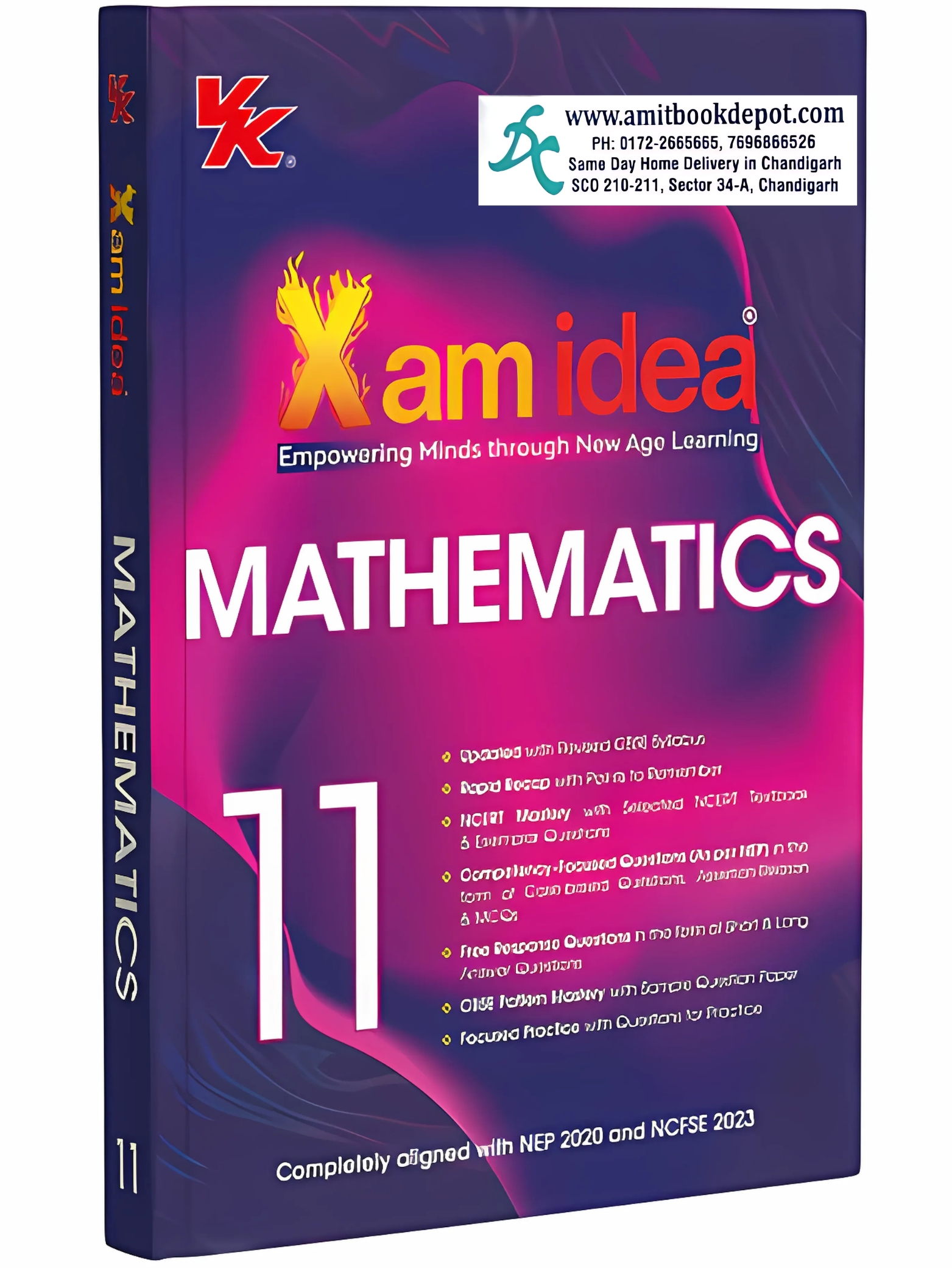
XAMIDEA Mathematics for Class 11th

by Madhurima
₹603 ₹603.00(-/ off)

Rating & Reviews

23 Customer Review

XAM IDEA Mathematics for Class 11 (2024-25 Edition) by VK Global Publications is a complete chapter-wise question bank meticulously designed for the latest CBSE syllabus. This comprehensive guide simplifies learning with ‘Points to Remember,’ detailed solutions to all NCERT book questions, and a vast collection of practice material. It features a diverse range of questions, including Multiple Choice Questions (MCQs), Case Study-based, Assertion-Reason, and Long & Short Answer types, fully aligned with the new CBSE pattern. Ideal for building a strong conceptual foundation and exam preparation, this book also includes previous years' questions and a sample question paper to help students excel in their Class 11 mathematics exam.

Have Doubts Regarding This Product ? Ask Your Question

  • Q1
    Is this book suitable for the CBSE Class 11 exams in 2024-2025?
    A1

    Yes, absolutely. This edition of XAM IDEA Mathematics for Class 11 has been specifically modeled and published for the 2024-25 academic session. It is strictly based on the revised CBSE syllabus for the current year .

  • Q2
    What types of questions are included, apart from the usual long and short answer types?
    A2

    To prepare students for the modern examination pattern, the book includes a wide variety of competency-focused questions. This includes Multiple Choice Questions (MCQs), Case Study-based questions, Assertion-Reason questions, and questions from previous years' board exams .

  • Q3
    Does this book help with understanding the basic concepts of each chapter?
    A3

    Definitely. Each chapter begins with a section called ‘Points to Remember’ or a summary of basic concepts. This feature helps students quickly revise the fundamental principles, formulas, and theorems before they start practicing the questions .

  • Q4
    What is the complete list of units covered in this book?
    A4

    The book comprehensively covers the entire Class 11 CBSE syllabus, divided into six units: 1. Sets and Functions, 2. Algebra, 3. Coordinate Geometry, 4. Calculus, 5. Mathematical Reasoning, and 6. Statistics and Probability.

  • Q5
    Does the book include questions from the topics like "Limits and Derivatives" and "Conic Sections"?
    A5

    Yes, it does. As per the detailed syllabus provided, the book has dedicated chapters on "Limits and Derivatives" under Unit IV: Calculus, and "Conic Sections" under Unit III: Coordinate Geometry, complete with relevant questions for practice.

  • Q6
    Is this book only for school exams, or can it be used for competitive exam preparation like JEE?
    A6

    While XAM IDEA is an excellent resource for building a strong foundation in Class 11 topics and excelling in school board exams, it is primarily designed for that purpose. It covers the basics thoroughly, which is the first step for any competitive exam, but for advanced JEE preparation, students may require additional specialized books.

  • Q7
    Are there separate practice questions at the end of each chapter?
    A7

    Yes, after the solved NCERT questions and other exercises, each chapter concludes with a dedicated 'Questions for Practice' section. This allows students to independently solve problems and reinforce their learning .

  • Q8
    Does the book cover topics like "Principle of Mathematical Induction" and "Binomial Theorem"?
    A8

    Yes, both topics are covered in detail. "Principle of Mathematical Induction" and "Binomial Theorem" are important chapters under Unit II: Algebra, and the book includes a variety of questions on them.

  • Q9
    Does this book include the latest changes in the CBSE syllabus for 2024-25?
    A9

    Yes, the publisher explicitly states that the book has been modeled as per the revised CBSE syllabus for the academic year 2024-25, ensuring that students are studying relevant and up-to-date material .

  • Q10
    Is there a sample paper included to practice the full exam pattern?
    A10

    Yes, the book includes a Sample Question Paper (Part - B as per your provided contents). This paper is designed according to the latest CBSE examination pattern, allowing students to simulate exam conditions and assess their preparedness .

0.00

0 Overall Rating
  • 5
    0
  • 4
    0
  • 3
    0
  • 2
    0
  • 1
    0

Try this product & share your review & thoughts

PART - A

1. Sets
2. Relations and Functions
3. Trigonometric Functions
4. Complex Numbers and Quadratic Equations
5. Linear Inequalities
6. Permutations and Combinations
7. Binomial Theorem
8. Sequence and Series
9. Straight Lines
10. Conic Sections
11. Introduction to Three-Dimensional Geometry
12. Limits and Derivatives
13. Statistics
14. Probability

PART - B
- Sample Question Paper

Latest Syllabus of XAMIDEA Mathematics for Class 11th Completely aligned with NEP 2020 and NCFSE 2023


UNIT I: SETS AND FUNCTIONS

1. Sets
Sets and their representations. Empty set. Finite and Infinite Sets. Equal sets. Subsets. Subsets of the set of real numbers, especially intervals (with notations). Power set. Universal set. Venn diagrams. Union and intersection of sets. Difference of sets. Complement of a Set, Properties of Complement Sets.

2. Relations and Functions
Ordered pairs, Cartesian product of sets. Number of elements in the Cartesian product of two finite sets. Cartesian product of the reals with itself (up to R × R × R). Definition of relation, pictorial diagrams, domain, co-domain, and range of a relation. Function as a special kind of relation from one set to another. Pictorial representation of a function, domain, co-domain, and range of a function. Real-valued function of the real variable, domain and range of these functions, constant, identity, polynomial, rational, modulus, signum, and greatest integer functions with their graphs. Sum, difference, product, and quotients of functions.

3. Trigonometric Functions
Positive and negative angles. Measuring angles in radians and in degrees and conversion from one measure to another. Definition of trigonometric functions with the help of the unit circle. The truth of the identity sin²x + cos²x = 1 for all x. Signs of trigonometric functions and sketches of their graphs. Expressing sin (x + y) and cos (x + y) in terms of sin x, sin y, cos x, and cos y. Identities related to sin2x, cos2x, tan2x, sin3x, cos3x, and tan3x. General solution of trigonometric equations of the type sin θ = sin α, cos θ = cos α, and tan θ = tan α. Proofs and simple applications of sine and cosine formulas.

UNIT II: ALGEBRA

1. Principle of Mathematical Induction
Process of the proof by induction, motivating the application of the method by looking at natural numbers as the least inductive subset of real numbers. The principle of mathematical induction and simple applications.

2. Complex Numbers and Quadratic Equations
The need for complex numbers, especially −1, to be motivated by the inability to solve every quadratic equation. Brief description of algebraic properties of complex numbers. Argand plane and polar representation of complex numbers. Statement of the Fundamental Theorem of Algebra, solution of quadratic equations in the complex number system, and square root of a complex number.

3. Linear Inequalities
Linear inequalities, algebraic solutions of linear inequalities in one variable, and their representation on the number line. Graphical solution of linear inequalities in two variables. Solution of a system of linear inequalities in two variables—graphically.

4. Permutations and Combinations
Fundamental principle of counting. Factorial n. Permutations and combinations: derivation of formulas and their connections, simple applications.

5. Binomial Theorem
History, statement, and proof of the binomial theorem for positive integral indices. Pascal’s triangle, general and middle terms in binomial expansion, and simple applications.

6. Sequence and Series
Sequence and Series. Arithmetic Progression (A.P.), Arithmetic Mean (A.M.), Geometric Progression (G.P.), general term of a G.P., sum of n terms of a G.P., arithmetic and geometric series, infinite G.P. and its sum, and geometric mean (G.M.). 

UNIT III: COORDINATE GEOMETRY

1. Straight Lines
Brief recall of 2-D from earlier classes, shifting of origin. Slope of a line and angle between two lines. Various forms of equations of a line: parallel to axes, point-slope form, slope-intercept form, two-point form, intercept form, and normal form. General equation of a line. Equation of a family of lines passing through the point of intersection of two lines. Distance of a point from a line.

2. Conic Sections
Sections of a cone: circles, ellipses, parabolas, hyperbolas, a point, a straight line, and a pair of intersecting lines as a degenerated case of a conic section. Standard equations and simple properties of parabola, ellipse, and hyperbola. Standard equation of a circle.

3. Introduction to Three-Dimensional Geometry
Coordinate axes and coordinate planes in three dimensions. Coordinates of a point. Distance between two points and section formula.

UNIT IV: CALCULUS

Limits and Derivatives The derivative is introduced as the rate of change both as that of the distance function and geometrically. Define derivative, relate it to the slope of the tangent of the curve, and define the derivative of the sum, difference, product, and quotient of functions. Derivatives of polynomial and trigonometric functions.

UNIT V: MATHEMATICAL REASONING

Mathematically acceptable statements. Connecting words/phrases—consolidating the understanding of “if and only if (necessary and sufficient) condition,” “implies,” “and/or,” “implied by,” “and,” “or,” “there exists,” and their use through a variety of examples related to real life and mathematics. Validating the statements involving the connecting words—the difference between contradiction, converse, and contrapositive.

UNIT VI: STATISTICS AND PROBABILITY

1. Statistics
Measure of dispersion: mean deviation, variance, and standard deviation of ungrouped/grouped data. Analysis of frequency distributions with equal means but different variances.

2. Probability 
Random experiments: outcomes, sample spaces (set representation). Events: Occurrence of events, ‘not,’ ‘and,’ & ‘or’ events, exhaustive events, and mutually exclusive events. Axiomatic (set theoretic) probability, connections with the theories of earlier classes. Probability of an event, probability of ‘not,’ ‘and,’ & ‘or’ events.

XAM IDEA Mathematics for Class 11 | CBSE Board | Chapter-wise Question Bank | Based on Revised CBSE Syllabus | 2024-25 Exam

VK Global Publications Pvt Ltd proudly presents the latest edition of XAM IDEA Mathematics for Class 11, a comprehensive and meticulously crafted resource designed to empower students in their academic journey and help them excel in their CBSE board examinations. This book is more than just a question bank; it is a complete learning and revision tool that aligns perfectly with the current CBSE curriculum, ensuring students are well-prepared for the challenges of the Class 11 Mathematics exam.

Adhering strictly to the syllabus prescribed by the CBSE, this edition of XAM IDEA is an invaluable asset for students aiming to build a strong foundation in mathematics. The book systematically covers the entire Class 11 syllabus, which is divided into six key units: Sets and Functions, Algebra, Coordinate Geometry, Calculus, Mathematical Reasoning, and Statistics & Probability. Every topic, from the basic representation of sets to the complexities of conic sections and the fundamentals of limits and derivatives, is explained with clarity and precision. The comprehensive nature of the book ensures that students can grasp the core concepts before moving on to application-based learning.

A standout feature of XAM IDEA is its chapter-wise organization, which mirrors the flow of the NCERT book. Each chapter begins with a crisp recap of fundamental concepts, often termed ‘Points to Remember.’ This section serves as a quick refresher, enabling students to revise key formulas, theorems, and principles before diving into problem-solving. The book provides complete solutions to all NCERT book questions, ensuring that students can cross-verify their answers and understand the correct methodology, a crucial step for building confidence.

Recognizing the evolving pattern of CBSE examinations, XAM IDEA incorporates a diverse array of question typologies. Students will find ample practice material, including:

1. Competency-Focused Questions: To test the application of concepts in real-life scenarios.
2. Multiple Choice Questions (MCQs): For a quick and effective way to test conceptual clarity.
3. Case Study-Based Questions: To develop analytical and problem-solving skills by applying mathematical concepts to real-world situations.
4. Assertion-Reason Questions: To enhance logical thinking and the ability to establish relationships between different statements.
5. Constructed Response Questions: This includes a wide range of short answer type questions and long answer type questions, providing thorough practice for the descriptive part of the examination.

Furthermore, the book includes a dedicated section of questions from previous years' examinations, giving students insight into the pattern and difficulty level of questions asked in the past. To ensure thorough preparation, each chapter concludes with a substantial ‘Questions for Practice’ section. This allows learners to independently test their understanding and reinforce their learning. The book also contains at least one sample question paper at the end, designed strictly as per the latest CBSE examination pattern, to provide students with a realistic exam-day experience.

Authored by an experienced editorial board, XAM IDEA Mathematics for Class 11 is published by VK Global Publications Pvt Ltd, a name synonymous with quality educational content. With its 2024-25 edition, this 465-page paperback is an essential guide for every Class 11 student. Whether for regular practice, revision, or final exam preparation, XAM IDEA is the perfect companion to master mathematics and achieve academic success. Its structured approach, variety of questions, and adherence to the latest syllabus make it an indispensable resource for the 2024-25 academic session.

PART - A

1. Sets
2. Relations and Functions
3. Trigonometric Functions
4. Complex Numbers and Quadratic Equations
5. Linear Inequalities
6. Permutations and Combinations
7. Binomial Theorem
8. Sequence and Series
9. Straight Lines
10. Conic Sections
11. Introduction to Three-Dimensional Geometry
12. Limits and Derivatives
13. Statistics
14. Probability

PART - B
- Sample Question Paper

Have Doubts Regarding This Product ? Ask Your Question

  • Q1
    Is this book suitable for the CBSE Class 11 exams in 2024-2025?
    A1

    Yes, absolutely. This edition of XAM IDEA Mathematics for Class 11 has been specifically modeled and published for the 2024-25 academic session. It is strictly based on the revised CBSE syllabus for the current year .

  • Q2
    What types of questions are included, apart from the usual long and short answer types?
    A2

    To prepare students for the modern examination pattern, the book includes a wide variety of competency-focused questions. This includes Multiple Choice Questions (MCQs), Case Study-based questions, Assertion-Reason questions, and questions from previous years' board exams .

  • Q3
    Does this book help with understanding the basic concepts of each chapter?
    A3

    Definitely. Each chapter begins with a section called ‘Points to Remember’ or a summary of basic concepts. This feature helps students quickly revise the fundamental principles, formulas, and theorems before they start practicing the questions .

  • Q4
    What is the complete list of units covered in this book?
    A4

    The book comprehensively covers the entire Class 11 CBSE syllabus, divided into six units: 1. Sets and Functions, 2. Algebra, 3. Coordinate Geometry, 4. Calculus, 5. Mathematical Reasoning, and 6. Statistics and Probability.

  • Q5
    Does the book include questions from the topics like "Limits and Derivatives" and "Conic Sections"?
    A5

    Yes, it does. As per the detailed syllabus provided, the book has dedicated chapters on "Limits and Derivatives" under Unit IV: Calculus, and "Conic Sections" under Unit III: Coordinate Geometry, complete with relevant questions for practice.

  • Q6
    Is this book only for school exams, or can it be used for competitive exam preparation like JEE?
    A6

    While XAM IDEA is an excellent resource for building a strong foundation in Class 11 topics and excelling in school board exams, it is primarily designed for that purpose. It covers the basics thoroughly, which is the first step for any competitive exam, but for advanced JEE preparation, students may require additional specialized books.

  • Q7
    Are there separate practice questions at the end of each chapter?
    A7

    Yes, after the solved NCERT questions and other exercises, each chapter concludes with a dedicated 'Questions for Practice' section. This allows students to independently solve problems and reinforce their learning .

  • Q8
    Does the book cover topics like "Principle of Mathematical Induction" and "Binomial Theorem"?
    A8

    Yes, both topics are covered in detail. "Principle of Mathematical Induction" and "Binomial Theorem" are important chapters under Unit II: Algebra, and the book includes a variety of questions on them.

  • Q9
    Does this book include the latest changes in the CBSE syllabus for 2024-25?
    A9

    Yes, the publisher explicitly states that the book has been modeled as per the revised CBSE syllabus for the academic year 2024-25, ensuring that students are studying relevant and up-to-date material .

  • Q10
    Is there a sample paper included to practice the full exam pattern?
    A10

    Yes, the book includes a Sample Question Paper (Part - B as per your provided contents). This paper is designed according to the latest CBSE examination pattern, allowing students to simulate exam conditions and assess their preparedness .

Latest Syllabus of XAMIDEA Mathematics for Class 11th Completely aligned with NEP 2020 and NCFSE 2023


UNIT I: SETS AND FUNCTIONS

1. Sets
Sets and their representations. Empty set. Finite and Infinite Sets. Equal sets. Subsets. Subsets of the set of real numbers, especially intervals (with notations). Power set. Universal set. Venn diagrams. Union and intersection of sets. Difference of sets. Complement of a Set, Properties of Complement Sets.

2. Relations and Functions
Ordered pairs, Cartesian product of sets. Number of elements in the Cartesian product of two finite sets. Cartesian product of the reals with itself (up to R × R × R). Definition of relation, pictorial diagrams, domain, co-domain, and range of a relation. Function as a special kind of relation from one set to another. Pictorial representation of a function, domain, co-domain, and range of a function. Real-valued function of the real variable, domain and range of these functions, constant, identity, polynomial, rational, modulus, signum, and greatest integer functions with their graphs. Sum, difference, product, and quotients of functions.

3. Trigonometric Functions
Positive and negative angles. Measuring angles in radians and in degrees and conversion from one measure to another. Definition of trigonometric functions with the help of the unit circle. The truth of the identity sin²x + cos²x = 1 for all x. Signs of trigonometric functions and sketches of their graphs. Expressing sin (x + y) and cos (x + y) in terms of sin x, sin y, cos x, and cos y. Identities related to sin2x, cos2x, tan2x, sin3x, cos3x, and tan3x. General solution of trigonometric equations of the type sin θ = sin α, cos θ = cos α, and tan θ = tan α. Proofs and simple applications of sine and cosine formulas.

UNIT II: ALGEBRA

1. Principle of Mathematical Induction
Process of the proof by induction, motivating the application of the method by looking at natural numbers as the least inductive subset of real numbers. The principle of mathematical induction and simple applications.

2. Complex Numbers and Quadratic Equations
The need for complex numbers, especially −1, to be motivated by the inability to solve every quadratic equation. Brief description of algebraic properties of complex numbers. Argand plane and polar representation of complex numbers. Statement of the Fundamental Theorem of Algebra, solution of quadratic equations in the complex number system, and square root of a complex number.

3. Linear Inequalities
Linear inequalities, algebraic solutions of linear inequalities in one variable, and their representation on the number line. Graphical solution of linear inequalities in two variables. Solution of a system of linear inequalities in two variables—graphically.

4. Permutations and Combinations
Fundamental principle of counting. Factorial n. Permutations and combinations: derivation of formulas and their connections, simple applications.

5. Binomial Theorem
History, statement, and proof of the binomial theorem for positive integral indices. Pascal’s triangle, general and middle terms in binomial expansion, and simple applications.

6. Sequence and Series
Sequence and Series. Arithmetic Progression (A.P.), Arithmetic Mean (A.M.), Geometric Progression (G.P.), general term of a G.P., sum of n terms of a G.P., arithmetic and geometric series, infinite G.P. and its sum, and geometric mean (G.M.). 

UNIT III: COORDINATE GEOMETRY

1. Straight Lines
Brief recall of 2-D from earlier classes, shifting of origin. Slope of a line and angle between two lines. Various forms of equations of a line: parallel to axes, point-slope form, slope-intercept form, two-point form, intercept form, and normal form. General equation of a line. Equation of a family of lines passing through the point of intersection of two lines. Distance of a point from a line.

2. Conic Sections
Sections of a cone: circles, ellipses, parabolas, hyperbolas, a point, a straight line, and a pair of intersecting lines as a degenerated case of a conic section. Standard equations and simple properties of parabola, ellipse, and hyperbola. Standard equation of a circle.

3. Introduction to Three-Dimensional Geometry
Coordinate axes and coordinate planes in three dimensions. Coordinates of a point. Distance between two points and section formula.

UNIT IV: CALCULUS

Limits and Derivatives The derivative is introduced as the rate of change both as that of the distance function and geometrically. Define derivative, relate it to the slope of the tangent of the curve, and define the derivative of the sum, difference, product, and quotient of functions. Derivatives of polynomial and trigonometric functions.

UNIT V: MATHEMATICAL REASONING

Mathematically acceptable statements. Connecting words/phrases—consolidating the understanding of “if and only if (necessary and sufficient) condition,” “implies,” “and/or,” “implied by,” “and,” “or,” “there exists,” and their use through a variety of examples related to real life and mathematics. Validating the statements involving the connecting words—the difference between contradiction, converse, and contrapositive.

UNIT VI: STATISTICS AND PROBABILITY

1. Statistics
Measure of dispersion: mean deviation, variance, and standard deviation of ungrouped/grouped data. Analysis of frequency distributions with equal means but different variances.

2. Probability 
Random experiments: outcomes, sample spaces (set representation). Events: Occurrence of events, ‘not,’ ‘and,’ & ‘or’ events, exhaustive events, and mutually exclusive events. Axiomatic (set theoretic) probability, connections with the theories of earlier classes. Probability of an event, probability of ‘not,’ ‘and,’ & ‘or’ events.

0.00

0 Overall Rating
  • 5
    0
  • 4
    0
  • 3
    0
  • 2
    0
  • 1
    0

Try this product & share your review & thoughts

Top Trending Product

Related Product

Related Product

Related Blog Posts

Latest Blogs

Latest Blogs

blog-img
Classic Literature Reimagined: Discuss modern twists on classic novels.
Lorem ipsum dolor sit amet, consectetur adipiscing elit, sed do eiusmod tempor incididunt ut labore et dolore magna aliqua. Ut enim ad minim veniam, quis nostrud exercitation ullamco Lorem ipsum dolor sit amet, consectetur adipiscing elit, sed do eiusmod tempor incididunt ut labore et dolore magna aliqua. Utenim ad minim veniam, quis nostrud exercitation ullamco Lorem ipsum dolor sit amet, consecte...
Read more
Author name | 10 jan, 2025
blog-img
Classic Literature Reimagined: Discuss modern twists on classic novels.
Lorem ipsum dolor sit amet, consectetur adipiscing elit, sed do eiusmod tempor incididunt ut labore et dolore magna aliqua. Ut enim ad minim veniam, quis nostrud exercitation ullamco Lorem ipsum dolor sit amet, consectetur adipiscing elit, sed do eiusmod tempor incididunt ut labore et dolore magna aliqua. Utenim ad minim veniam, quis nostrud exercitation ullamco Lorem ipsum dolor sit amet, consecte...
Read more
Author name | 10 jan, 2025
blog-img
Classic Literature Reimagined: Discuss modern twists on classic novels.
Lorem ipsum dolor sit amet, consectetur adipiscing elit, sed do eiusmod tempor incididunt ut labore et dolore magna aliqua. Ut enim ad minim veniam, quis nostrud exercitation ullamco Lorem ipsum dolor sit amet, consectetur adipiscing elit, sed do eiusmod tempor incididunt ut labore et dolore magna aliqua. Utenim ad minim veniam, quis nostrud exercitation ullamco Lorem ipsum dolor sit amet, consecte...
Read more
Author name | 10 jan, 2025
blog-img
Classic Literature Reimagined: Discuss modern twists on classic novels.
Lorem ipsum dolor sit amet, consectetur adipiscing elit...
Read more
Author Name | 10 Jan, 2025
blog-img
Classic Literature Reimagined: Discuss modern twists on classic novels.
Lorem ipsum dolor sit amet, consectetur adipiscing elit...
Read more
Author Name | 10 Jan, 2025
blog-img
Classic Literature Reimagined: Discuss modern twists on classic novels.
Lorem ipsum dolor sit amet, consectetur adipiscing elit...
Read more
Author Name | 10 Jan, 2025
blog-img
Classic Literature Reimagined: Discuss modern twists on classic novels.
Lorem ipsum dolor sit amet, consectetur adipiscing elit...
Read more
Author Name | 10 Jan, 2025
blog-img
Classic Literature Reimagined: Discuss modern twists on classic novels.
Lorem ipsum dolor sit amet, consectetur adipiscing elit...
Read more
Author Name | 10 Jan, 2025
blog-img
Classic Literature Reimagined: Discuss modern twists on classic novels.
Lorem ipsum dolor sit amet, consectetur adipiscing elit...
Read more
Author Name | 10 Jan, 2025
blog-img
Classic Literature Reimagined: Discuss modern twists on classic novels.
Lorem ipsum dolor sit amet, consectetur adipiscing elit...
Read more
Author Name | 10 Jan, 2025
blog-img
Classic Literature Reimagined: Discuss modern twists on classic novels.
Lorem ipsum dolor sit amet, consectetur adipiscing elit...
Read more
Author Name | 10 Jan, 2025
blog-img
Classic Literature Reimagined: Discuss modern twists on classic novels.
Lorem ipsum dolor sit amet, consectetur adipiscing elit...
Read more
Author Name | 10 Jan, 2025