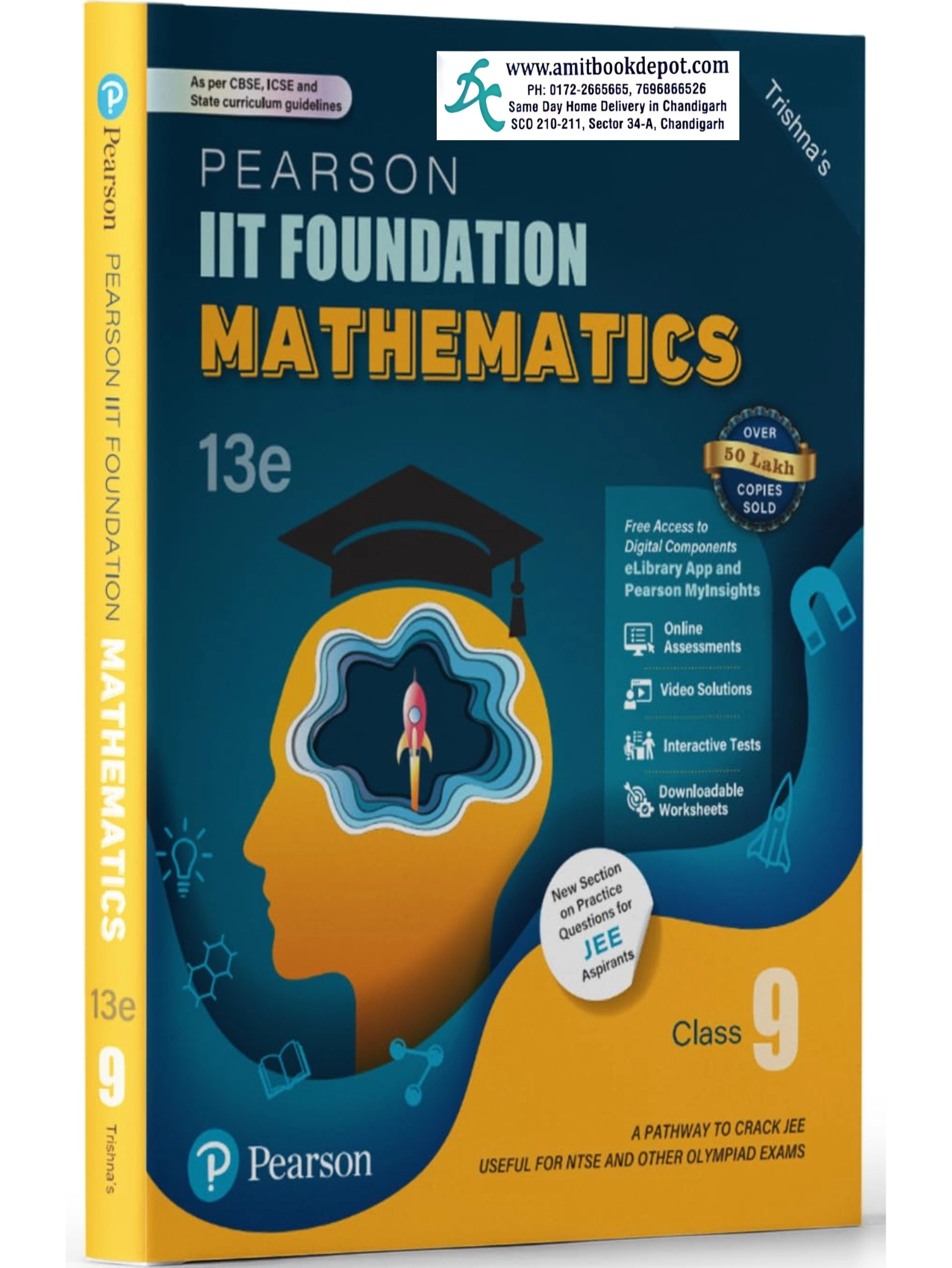
The Pearson IIT Foundation Series Mathematics for Class 9 is a strategically designed academic resource, meticulously crafted to build a formidable foundation for students aspiring to excel in competitive engineering entrance examinations like the IIT-JEE, NEET, and other national/state-level Olympiads, while simultaneously strengthening their core school curriculum (CBSE, ICSE, and State Boards). This book transcends the conventional book approach by integrating the fundamental concepts of Class 9 with the analytical rigor and problem-solving techniques required for advanced studies.
This comprehensive guide begins by cementing the understanding of basic numerical systems in "Real Numbers," delving into natural numbers, whole numbers, radicals, and surds, establishing the critical bedrock for all higher mathematics. It then progresses to applied arithmetic concepts crucial for both academics and real-life scenarios in "Ratio, Proportion, and Variation" and "Percentages, Profit and Loss, Discount, and Partnership." Financial mathematics is covered in depth with dedicated chapters on "Simple Interest and Compound Interest," ensuring conceptual clarity in growth and depreciation models.
The core of algebraic thinking is developed through "Polynomials and Square Roots of Algebraic Expressions," which covers polynomial operations and factorization—a vital skill for solving complex equations. This leads seamlessly into "Linear Equations in Two Variables," introducing students to graphical and algebraic methods for solving simultaneous equations. The abstract mathematical structures are introduced in "Sets and Relations," including the Cartesian Product, forming the basis for modern mathematics. A dedicated chapter on "Logarithm" introduces this indispensable tool for scientific calculations and advanced mathematics.
A significant portion of the book is devoted to strengthening geometrical intuition and deductive reasoning. The "Geometry" chapter is exhaustive, covering lines, angles, triangles, quadrilaterals, circles, polygons, and key theorems on triangles and areas. It is uniquely complemented by practical sections on the "Construction of Triangles" and "Construction of Quadrilaterals," bridging theory with application. This is followed by "Mensuration," which provides formulas and techniques to calculate areas of plane figures, polygons, and volumes of various solids.
The bridge between algebra and geometry is elegantly presented in "Coordinate Geometry," where students learn to plot points on the plane, understand equations of straight lines, and apply the section formula. The introduction to "Trigonometry" lays the groundwork with trigonometric ratios for acute angles, a precursor to more advanced trigonometric concepts.
The book also incorporates essential elements of data science and chance through "Statistics" and "Probability." The statistics module covers data representation via statistical graphs, detailed analysis using measures of central tendencies for both ungrouped and grouped data, and concepts of dispersion like range, quartiles, and mean deviation. The "Probability" chapter introduces the fundamental principles of chance, completing the mathematical toolkit for Class 9.
Key features that distinguish this IIT Foundation series book include a lucid, step-by-step explanation of concepts, a hierarchy of solved examples that progress from simple to complex, and a vast repository of practice problems categorized into Check Your Understanding, Challenge Questions, and Previous Years' Competition Problems. The content is structured to encourage self-study, fostering analytical thinking and problem-solving dexterity. The focus is not on rote memorization but on developing a deep, intuitive understanding of the "why" behind every mathematical principle.
Published by Pearson Education, a global leader in educational content, this book assures pedagogical excellence and accuracy. It is an indispensable investment for every serious Class 9 student targeting top-tier engineering careers, ensuring they are not just exam-ready but future-ready, with a robust and unshakeable foundation in mathematics.