Categories
College Bookssss >
BA PU Chandigarh
BSC PU Chandigarh
MSC PU Chandigarh
BBA PU Chandigarh
MA PU Chandigarh
Medical Books
Engineering Books
Management Books
PGDCA Books
BCOM PU Chandigarh
MCOM PU Chandigarh
BCA PU Chandigarh
MCA PU Chandigarh
animate-books

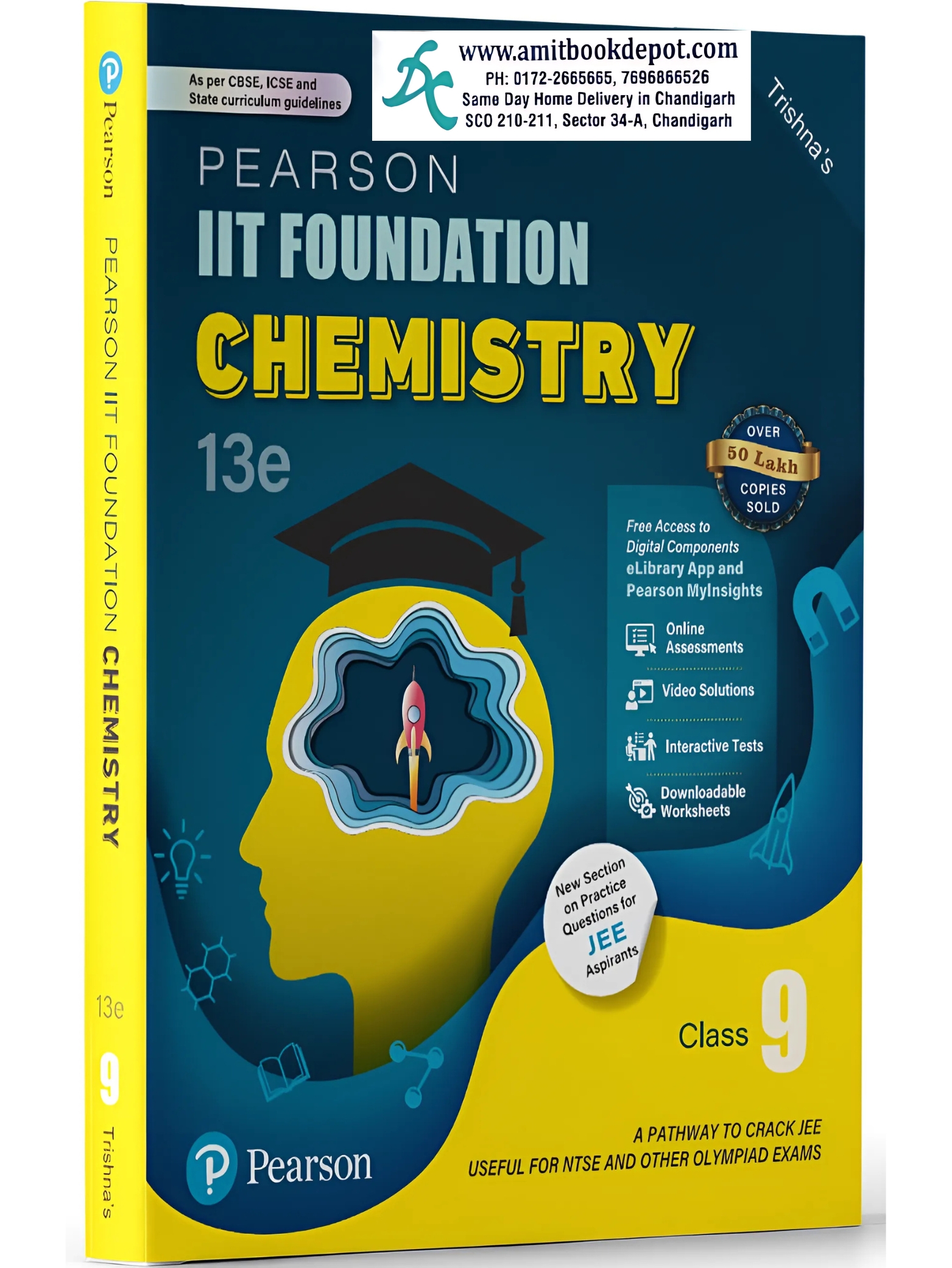
Pearson IIT Foundation Series Chemistry for Class 9th

by Madhurima
โ‚น440 โ‚น440.00(-/ off)

Rating & Reviews

23 Customer Review

The Pearson IIT Foundation Series - Chemistry Class 9 is a definitive book designed to build a powerful foundation for competitive exams like IIT-JEE, NEET, and Olympiads alongside school boards (CBSE/ICSE). It comprehensively covers physical chemistry (matter, mole concept, atomic structure, gases, and equilibrium) and inorganic chemistry (periodic table, chemical bonding, water, metals & non-metals). With clear explanations, practice questions, and detailed answer keys with hints, it masterfully explains complex topics such as stoichiometry, quantum numbers, electrolysis, and periodicity. This book is an essential resource for developing strong conceptual understanding and exceptional problem-solving skills in chemistry.

Have Doubts Regarding This Product ? Ask Your Question

  • Q1
    Is this book suitable for both CBSE/ICSE school exams and early competitive exam preparation?
    A1

    Yes. It is uniquely structured to explain the core Class 9 syllabus with the depth and application-based approach required for foundational preparation for IIT-JEE, NEET, and Olympiads. The concepts are built from the ground up to serve both purposes simultaneously.

  • Q2
    How are advanced topics like Chemical Kinetics and Quantum Numbers introduced for a Class 9 student?
    A2

    These topics are introduced in a conceptual, foundational manner, avoiding excessive complexity. The focus is on building the core idea (e.g., what is reaction rate, what are quantum numbers for) to create a strong base for deeper study in higher classes, not on overwhelming the student.

  • Q3
    Does the book provide step-by-step solutions or just final answers?
    A3

    It provides comprehensive Answer Keys and separate Hints and Explanations. This dual approach allows you to check your answer first and then understand the reasoning and method behind solving the problem.

  • Q4
    What is the balance between theoretical concepts and numerical problems?
    A4

    The book emphasizes a strong link between theory and application. Chapters like Mole Concept and Gas Laws are rich with numerical problems, while others like Periodic Table focus on conceptual understanding and comparative analysis, all essential for problem-solving.

  • Q5
    Are practical applications, like Chromatography and Electrolysis, explained with real-world context?
    A5

    Yes. Topics such as Paper Chromatography, Hardness of Water, and Electrolysis are explained with their principles and practical significance, helping students connect textbook chemistry to real-life phenomena and industrial processes.

  • Q6
    How does the book handle the progression from historical atomic models to modern atomic theory?
    A6

    Chapter 4 (Atomic Structure) deliberately takes a historical journeyโ€”from Thomson to Rutherford to Bohr and finally the quantum mechanical model. This helps students appreciate how scientific understanding evolves and solidifies the logic behind complex concepts like orbitals.

  • Q7
    For self-study, is the language accessible without constant teacher guidance?
    A7

    The language is clear and systematic. Complex ideas are broken down into logical subsections. Combined with the detailed hints, it is designed to be a self-contained guide for motivated students.

  • Q8
    Does the Chemical Bonding chapter clearly differentiate between Ionic, Covalent, and Coordinate bonds with relatable examples?
    A8

    Absolutely. Each bond type is defined with formation mechanisms, typical properties, and common examples, with special emphasis on understanding polarity and the unique nature of hydrogen bonding and coordinate bonds.

  • Q9
    Are the diagrams (e.g., Orbital Shapes, Blast Furnace) sufficiently detailed and labeled?
    A9

    Yes. The book includes well-labeled, clear diagrams and illustrations that are essential for visualizing abstract concepts (like orbital shapes) and complex processes (like the metallurgy of iron in a blast furnace).

  • Q10
    Does the Water chapter simply list properties, or does it explain concepts like solubility curves and colloids?
    A10

    It delves into conceptual explanations. It covers solubility curves and their interpretation, the science behind colloids, and the difference between efflorescence and deliquescence, moving beyond rote learning.


0.00

0 Overall Rating
  • 5
    0
  • 4
    0
  • 3
    0
  • 2
    0
  • 1
    0

Try this product & share your review & thoughts

UNIT I : PHYSICAL CHEMISTRY

CHAPTER 1 : NATURE OF MATTER
1. Kinetic Molecular Theory of Matter Different States of Matter and Their Properties Interconversion of States of Matter
- Interconversion Between Solid and Liquid States 
- Interconversion Between the Liquid and 
- Gaseous States
- Latent Heat

2. Classification of Matter on the Basis of Chemical Composition
- Characteristics of Elements
- Characteristics of Compounds
- Characteristics of a Mixture

3. Separation of a Mixture
- Paper Chromatography

4. Chemical Changes and Chemical Reactions
- Conditions Required for Chemical Changes
- Displacement Reaction
- Exothermic and Endothermic Reactions
- Practice Questions
- Answer Keys
- Hints and Explanations

CHAPTER 2 : BASIC CONCEPTS OF CHEMISTRY
1. Language of Chemistry
- Representation of Chemical Changes
- Valency
- Derivation of Formulae of Compounds
- Naming of Inorganic Compounds

2. Atomic Mass
- Relative Atomic Mass and Atomic Mass Unit
- Gram Atomic Mass or Gram Atom
- Molecular Mass or Relative Molecular Mass
- Gram Molecular Mass or Gram Molecule
- Atomicity of an Element

3. Chemical Equations Equivalent Mass
- Relation Between Equivalent Mass and Atomic Mass

4. Laws of Chemical Combination and Types of Chemical Reactions
- Law of Reciprocal Proportions

5. Types of Chemical Reactions
- Combination Reactions
- Decomposition Reactions
- Displacement Reaction
- Double Decomposition/Double Displacement Reactions
- Exothermic Reactions
- Endothermic Reactions
- Oxidation and Reduction Reactions

6. Solutions and Solubility
- Classifications of Solutions
- Solubility
- Solubility Curves
- Practice Questions
- Answer Keys
- Hints and Explanations

CHAPTER 3 : MOLE CONCEPT, STOICHIOMETRY, AND BEHAVIOUR OF GASES
1. Symbols and Formulae
- Radical or Ions
- Derivation of Formulae of Compounds
- Naming of Compounds

2. Kinetic Theory of Gases
- Characteristics of Gases Based on the Kinetic
- Theory of Gases

3. Gas Laws
- Boyleโ€™s Law
- Charlesโ€™ Law
- The Gas Equations
- Standard/Normal Temperature and Pressure (STP or NTP)
- Gay - Lussacโ€™s Law of Combining Volumes of Gases
- Avogadroโ€™s law
- The Ideal Gas Law


4. Measurement of the Mass of Atoms and Molecules

- Avogadro's Number and Mole Concept
- Graham's Law of Diffusion

5. Stoichiometry

- Balancing of Chemical Equations by Trial and Error Method
- Calculation of Empirical and Molecular
- Formulae of Compounds
- Practice Questions
- Answer Keys
- Hints and Explanations

CHAPTER 4: ATOMIC STRUCTURE

1. Discovery of Fundamental Particles
- Discovery of Electrons
- Millikan's Oil Drop Experiment
- Discovery of Protons
- Discovery of Neutrons

2. Atomic Models
- Thomson's Atomic Model
- Rutherford's x-ray Scattering Experiments
- Quantum Theory of Radiation
- Bohr's Model
- Sommerfeld's Extension of Bohr's Theory

3. Dual Nature of Electron-de Broglie's Theory
- Quantum Numbers
- Principal Quantum Number
- Azimuthal Quantum Number
- Magnetic Quantum Number
- Spin Quantum Number
- Pauli's Exclusion Principle

4. Representation of an Orbital
- Shapes of the Orbitals

5. Electronic Configuration of Atoms
- Rules for Filling Up of Electrons in the Orbitals
- Practice Questions
- Answer Keys
- Hints and Explanations

CHAPTER 5: CHEMICAL KINETICS AND EQUILIBRIUM

1. Classification of Reactions Rate of a Chemical Reaction
- Units of Rate of Reaction
- Average Reaction Rate versus Instantaneous
- Reaction Rate
- Factors Influencing the Rate of a Reaction

2. Rate Law Chemical Equilibrium
- Reveruble and Irreversible Reactions
- Dynamic Esponibriom
- Ideunification of Equilibrium
- Law of Chemical Equilibrium or Law of
- Equilibrium Constant in Terms of Partial Pressure
- Mau Action
- Factors Affecting the Equilibrium
- Prater Questions
- Amr Kr
- Hints and Explanations

UNIT II: INORGANIC CHEMISTRY

CHAPTER 6: PERIODIC CLASSIFICATION OF ELEMENTS

1. Why Do We Need to Classify Elements?
- Dรถbereiner's Triads
- Dรถbereiner's Triads: Merits and Demerits

2. Newland's Arrangement of Elements in Octaves
- Mendeleev's Periodic Table
-Merits of Mendeleev's Periodic Table
- Limitations of Mendeleev's Periodic Table

3. Modern Periodic Table-The Long Form of the Periodic Table
- Periods Some Characteristics of Periods are
- Tabulated Below
- Groups
- Merits of the Long Form of the Periodic Table
- Defects of the Long Form of the Periodic Table

4. Periodicity
- Atomic Size
- Ionization Energy
- Electron Affinity
- Electronegativity
- Electropositive Character
- Oxidizing and Reducing Property
- Practice Questions
- Metallic and Non-metallic Property
- Answer Keys
- Hints and Explanations

CHAPTER 7: CHEMICAL BONDING
1. Chemical Bond
- Types of Chemical Bonds

2. Ionic Bond
- mLewis Dot Formula

3. Covalent Bond
- Energy Changes During Covalent Bond
- Formation
- Non-Polar Covalent Bonds
- Polar Covalent Bond

4. Coordinate Bond Hydrogen Bonding Metallic Bond Redox Reactions
- Oxidation
- Reduction
- Practice Questions
- Answer Keys
- Hints and Explanations

CHAPTER 8: WATER
1. Sources of Water Hard Water and Soft Water
- Hardness of Water

2. Important Properties of Water
- Solutions
- Solubility
- Factor effecting solubility
- Concentration of Solution
- Crystallisation
- Efflorescence and Deliquescence
- Hygroscopic Substances and Desiccating Agents

3. Colloids
- Properties of Colloid

4. Action of Water on Some Metals Electrolysis of Water
- Mechanism of Electrolysis
- Faraday's Laws of Electrolysis
- Practice Questions
- Answer Keys
- Hints and Explanations

CHAPTER 9: METALS AND NON-METALS
1. Metallurgy Metallurgy of Iron
- Smelting in Blast Furnace
- Steel

2. Non-Metals
- Hydrogen
- Carbon
- Nitrogen
- Phosphorous
- Oxygen
- Sulphur
- Chlorine
- Practice Questions
- Answer Keys
- Hints and Explanations
- Photo Credit

The Pearson IIT Foundation Series - Chemistry Class 9 is a meticulously crafted academic resource designed to build an unshakeable foundation in chemistry for aspiring students. This book is an indispensable guide for those targeting competitive examinations like the IIT-JEE, NEET, NTSE, and Olympiads, while simultaneously strengthening their grasp of the CBSE, ICSE, and other state board syllabi. It transcends the conventional book approach by introducing fundamental concepts with exceptional clarity and progressively building complexity, ensuring a seamless transition from basic to advanced learning.

Structured into two comprehensive unitsโ€”Physical Chemistry and Inorganic Chemistryโ€”the book methodically covers the entire Class 9 chemistry curriculum and beyond. Unit I: Physical Chemistry begins with the Nature of Matter, explaining the Kinetic Molecular Theory, states of matter, and interconversion processes like melting and vaporization, including the concept of latent heat. It establishes a strong base with the classification of matter and techniques for the separation of mixtures, such as paper chromatography, and delves into chemical changes, displacement reactions, and exothermic and endothermic reactions. The subsequent chapter on Basic Concepts of Chemistry demystifies the language of chemistry, covering valency, chemical formulae, naming of inorganic compounds, and atomic mass (gram atomic mass, molecular mass). It thoroughly explains the laws of chemical combination, types of chemical reactions (combination, decomposition, and displacement), and introduces solutions, solubility, and solubility curves.

A significant focus is placed on the mole concept, stoichiometry, and behavior of gases. This chapter is critical for mastering quantitative chemistry, detailing gas laws (Boyle's Law, Charles's Law, Gay-Lussac's Law, and Avogadro's Law), the ideal gas equation, and STP/NTP. It provides an in-depth exploration of the mole concept, Avogadro's number, Graham's law of diffusion, and stoichiometry calculations, including balancing chemical equations and determining empirical and molecular formulae. The unit concludes with pivotal chapters on Atomic Structure, tracing discoveries from fundamental particles to modern quantum mechanics, including atomic models (Thomson, Rutherford, and Bohr), quantum numbers, electronic configuration, and orbital shapes; and Chemical Kinetics and Equilibrium, introducing reaction rates, rate laws, and the principles of chemical equilibrium, Le Chatelier's principle, and the law of mass action.

Unit II: Inorganic Chemistry systematically explores the organization and behavior of elements. The Periodic Classification of Elements chapter charts the evolution from Dรถbereiner's triads and Mendeleev's periodic table to the modern periodic table, analyzing periodicity in properties like atomic size, ionization energy, electron affinity, and electronegativity. The Chemical Bonding chapter extensively covers ionic bonds, covalent bonds (polar and non-polar), coordinate bonds, hydrogen bonding, and redox reactions. Practical applications are addressed in the Water chapter, discussing hard and soft water, solubility, concentration of solutions, colloids, and electrolysis (Faraday's laws). Finally, the Metals and Non-Metals chapter provides insights into metallurgy (like the blast furnace process for iron) and the properties and uses of key non-metals such as hydrogen, carbon, nitrogen, and oxygen.

A hallmark of the Pearson IIT Foundation Series is its robust pedagogical framework. Each chapter is reinforced with a vast array of graded practice questions, ranging from foundational to highly challenging. Detailed answer keys and step-by-step hints and explanations empower students for self-assessment and conceptual clarity. This book is more than a book; it is a comprehensive learning system that fosters analytical thinking, problem-solving skills, and a deep-seated understanding of chemistry, perfectly aligning with the needs of dedicated Class 9 students preparing for a future in engineering, medicine, and scientific fields.

UNIT I : PHYSICAL CHEMISTRY

CHAPTER 1 : NATURE OF MATTER
1. Kinetic Molecular Theory of Matter Different States of Matter and Their Properties Interconversion of States of Matter
- Interconversion Between Solid and Liquid States 
- Interconversion Between the Liquid and 
- Gaseous States
- Latent Heat

2. Classification of Matter on the Basis of Chemical Composition
- Characteristics of Elements
- Characteristics of Compounds
- Characteristics of a Mixture

3. Separation of a Mixture
- Paper Chromatography

4. Chemical Changes and Chemical Reactions
- Conditions Required for Chemical Changes
- Displacement Reaction
- Exothermic and Endothermic Reactions
- Practice Questions
- Answer Keys
- Hints and Explanations

CHAPTER 2 : BASIC CONCEPTS OF CHEMISTRY
1. Language of Chemistry
- Representation of Chemical Changes
- Valency
- Derivation of Formulae of Compounds
- Naming of Inorganic Compounds

2. Atomic Mass
- Relative Atomic Mass and Atomic Mass Unit
- Gram Atomic Mass or Gram Atom
- Molecular Mass or Relative Molecular Mass
- Gram Molecular Mass or Gram Molecule
- Atomicity of an Element

3. Chemical Equations Equivalent Mass
- Relation Between Equivalent Mass and Atomic Mass

4. Laws of Chemical Combination and Types of Chemical Reactions
- Law of Reciprocal Proportions

5. Types of Chemical Reactions
- Combination Reactions
- Decomposition Reactions
- Displacement Reaction
- Double Decomposition/Double Displacement Reactions
- Exothermic Reactions
- Endothermic Reactions
- Oxidation and Reduction Reactions

6. Solutions and Solubility
- Classifications of Solutions
- Solubility
- Solubility Curves
- Practice Questions
- Answer Keys
- Hints and Explanations

CHAPTER 3 : MOLE CONCEPT, STOICHIOMETRY, AND BEHAVIOUR OF GASES
1. Symbols and Formulae
- Radical or Ions
- Derivation of Formulae of Compounds
- Naming of Compounds

2. Kinetic Theory of Gases
- Characteristics of Gases Based on the Kinetic
- Theory of Gases

3. Gas Laws
- Boyleโ€™s Law
- Charlesโ€™ Law
- The Gas Equations
- Standard/Normal Temperature and Pressure (STP or NTP)
- Gay - Lussacโ€™s Law of Combining Volumes of Gases
- Avogadroโ€™s law
- The Ideal Gas Law


4. Measurement of the Mass of Atoms and Molecules

- Avogadro's Number and Mole Concept
- Graham's Law of Diffusion

5. Stoichiometry

- Balancing of Chemical Equations by Trial and Error Method
- Calculation of Empirical and Molecular
- Formulae of Compounds
- Practice Questions
- Answer Keys
- Hints and Explanations

CHAPTER 4: ATOMIC STRUCTURE

1. Discovery of Fundamental Particles
- Discovery of Electrons
- Millikan's Oil Drop Experiment
- Discovery of Protons
- Discovery of Neutrons

2. Atomic Models
- Thomson's Atomic Model
- Rutherford's x-ray Scattering Experiments
- Quantum Theory of Radiation
- Bohr's Model
- Sommerfeld's Extension of Bohr's Theory

3. Dual Nature of Electron-de Broglie's Theory
- Quantum Numbers
- Principal Quantum Number
- Azimuthal Quantum Number
- Magnetic Quantum Number
- Spin Quantum Number
- Pauli's Exclusion Principle

4. Representation of an Orbital
- Shapes of the Orbitals

5. Electronic Configuration of Atoms
- Rules for Filling Up of Electrons in the Orbitals
- Practice Questions
- Answer Keys
- Hints and Explanations

CHAPTER 5: CHEMICAL KINETICS AND EQUILIBRIUM

1. Classification of Reactions Rate of a Chemical Reaction
- Units of Rate of Reaction
- Average Reaction Rate versus Instantaneous
- Reaction Rate
- Factors Influencing the Rate of a Reaction

2. Rate Law Chemical Equilibrium
- Reveruble and Irreversible Reactions
- Dynamic Esponibriom
- Ideunification of Equilibrium
- Law of Chemical Equilibrium or Law of
- Equilibrium Constant in Terms of Partial Pressure
- Mau Action
- Factors Affecting the Equilibrium
- Prater Questions
- Amr Kr
- Hints and Explanations

UNIT II: INORGANIC CHEMISTRY

CHAPTER 6: PERIODIC CLASSIFICATION OF ELEMENTS

1. Why Do We Need to Classify Elements?
- Dรถbereiner's Triads
- Dรถbereiner's Triads: Merits and Demerits

2. Newland's Arrangement of Elements in Octaves
- Mendeleev's Periodic Table
-Merits of Mendeleev's Periodic Table
- Limitations of Mendeleev's Periodic Table

3. Modern Periodic Table-The Long Form of the Periodic Table
- Periods Some Characteristics of Periods are
- Tabulated Below
- Groups
- Merits of the Long Form of the Periodic Table
- Defects of the Long Form of the Periodic Table

4. Periodicity
- Atomic Size
- Ionization Energy
- Electron Affinity
- Electronegativity
- Electropositive Character
- Oxidizing and Reducing Property
- Practice Questions
- Metallic and Non-metallic Property
- Answer Keys
- Hints and Explanations

CHAPTER 7: CHEMICAL BONDING
1. Chemical Bond
- Types of Chemical Bonds

2. Ionic Bond
- mLewis Dot Formula

3. Covalent Bond
- Energy Changes During Covalent Bond
- Formation
- Non-Polar Covalent Bonds
- Polar Covalent Bond

4. Coordinate Bond Hydrogen Bonding Metallic Bond Redox Reactions
- Oxidation
- Reduction
- Practice Questions
- Answer Keys
- Hints and Explanations

CHAPTER 8: WATER
1. Sources of Water Hard Water and Soft Water
- Hardness of Water

2. Important Properties of Water
- Solutions
- Solubility
- Factor effecting solubility
- Concentration of Solution
- Crystallisation
- Efflorescence and Deliquescence
- Hygroscopic Substances and Desiccating Agents

3. Colloids
- Properties of Colloid

4. Action of Water on Some Metals Electrolysis of Water
- Mechanism of Electrolysis
- Faraday's Laws of Electrolysis
- Practice Questions
- Answer Keys
- Hints and Explanations

CHAPTER 9: METALS AND NON-METALS
1. Metallurgy Metallurgy of Iron
- Smelting in Blast Furnace
- Steel

2. Non-Metals
- Hydrogen
- Carbon
- Nitrogen
- Phosphorous
- Oxygen
- Sulphur
- Chlorine
- Practice Questions
- Answer Keys
- Hints and Explanations
- Photo Credit

Have Doubts Regarding This Product ? Ask Your Question

  • Q1
    Is this book suitable for both CBSE/ICSE school exams and early competitive exam preparation?
    A1

    Yes. It is uniquely structured to explain the core Class 9 syllabus with the depth and application-based approach required for foundational preparation for IIT-JEE, NEET, and Olympiads. The concepts are built from the ground up to serve both purposes simultaneously.

  • Q2
    How are advanced topics like Chemical Kinetics and Quantum Numbers introduced for a Class 9 student?
    A2

    These topics are introduced in a conceptual, foundational manner, avoiding excessive complexity. The focus is on building the core idea (e.g., what is reaction rate, what are quantum numbers for) to create a strong base for deeper study in higher classes, not on overwhelming the student.

  • Q3
    Does the book provide step-by-step solutions or just final answers?
    A3

    It provides comprehensive Answer Keys and separate Hints and Explanations. This dual approach allows you to check your answer first and then understand the reasoning and method behind solving the problem.

  • Q4
    What is the balance between theoretical concepts and numerical problems?
    A4

    The book emphasizes a strong link between theory and application. Chapters like Mole Concept and Gas Laws are rich with numerical problems, while others like Periodic Table focus on conceptual understanding and comparative analysis, all essential for problem-solving.

  • Q5
    Are practical applications, like Chromatography and Electrolysis, explained with real-world context?
    A5

    Yes. Topics such as Paper Chromatography, Hardness of Water, and Electrolysis are explained with their principles and practical significance, helping students connect textbook chemistry to real-life phenomena and industrial processes.

  • Q6
    How does the book handle the progression from historical atomic models to modern atomic theory?
    A6

    Chapter 4 (Atomic Structure) deliberately takes a historical journeyโ€”from Thomson to Rutherford to Bohr and finally the quantum mechanical model. This helps students appreciate how scientific understanding evolves and solidifies the logic behind complex concepts like orbitals.

  • Q7
    For self-study, is the language accessible without constant teacher guidance?
    A7

    The language is clear and systematic. Complex ideas are broken down into logical subsections. Combined with the detailed hints, it is designed to be a self-contained guide for motivated students.

  • Q8
    Does the Chemical Bonding chapter clearly differentiate between Ionic, Covalent, and Coordinate bonds with relatable examples?
    A8

    Absolutely. Each bond type is defined with formation mechanisms, typical properties, and common examples, with special emphasis on understanding polarity and the unique nature of hydrogen bonding and coordinate bonds.

  • Q9
    Are the diagrams (e.g., Orbital Shapes, Blast Furnace) sufficiently detailed and labeled?
    A9

    Yes. The book includes well-labeled, clear diagrams and illustrations that are essential for visualizing abstract concepts (like orbital shapes) and complex processes (like the metallurgy of iron in a blast furnace).

  • Q10
    Does the Water chapter simply list properties, or does it explain concepts like solubility curves and colloids?
    A10

    It delves into conceptual explanations. It covers solubility curves and their interpretation, the science behind colloids, and the difference between efflorescence and deliquescence, moving beyond rote learning.

No Syllabus Added

0.00

0 Overall Rating
  • 5
    0
  • 4
    0
  • 3
    0
  • 2
    0
  • 1
    0

Try this product & share your review & thoughts

Top Trending Product

Related Product

Related Product

Related Blog Posts

Latest Blogs

Latest Blogs

blog-img
Classic Literature Reimagined: Discuss modern twists on classic novels.
Lorem ipsum dolor sit amet, consectetur adipiscing elit, sed do eiusmod tempor incididunt ut labore et dolore magna aliqua. Ut enim ad minim veniam, quis nostrud exercitation ullamco Lorem ipsum dolor sit amet, consectetur adipiscing elit, sed do eiusmod tempor incididunt ut labore et dolore magna aliqua. Utenim ad minim veniam, quis nostrud exercitation ullamco Lorem ipsum dolor sit amet, consecte...
Read more
Author name | 10 jan, 2025
blog-img
Classic Literature Reimagined: Discuss modern twists on classic novels.
Lorem ipsum dolor sit amet, consectetur adipiscing elit, sed do eiusmod tempor incididunt ut labore et dolore magna aliqua. Ut enim ad minim veniam, quis nostrud exercitation ullamco Lorem ipsum dolor sit amet, consectetur adipiscing elit, sed do eiusmod tempor incididunt ut labore et dolore magna aliqua. Utenim ad minim veniam, quis nostrud exercitation ullamco Lorem ipsum dolor sit amet, consecte...
Read more
Author name | 10 jan, 2025
blog-img
Classic Literature Reimagined: Discuss modern twists on classic novels.
Lorem ipsum dolor sit amet, consectetur adipiscing elit, sed do eiusmod tempor incididunt ut labore et dolore magna aliqua. Ut enim ad minim veniam, quis nostrud exercitation ullamco Lorem ipsum dolor sit amet, consectetur adipiscing elit, sed do eiusmod tempor incididunt ut labore et dolore magna aliqua. Utenim ad minim veniam, quis nostrud exercitation ullamco Lorem ipsum dolor sit amet, consecte...
Read more
Author name | 10 jan, 2025
blog-img
Classic Literature Reimagined: Discuss modern twists on classic novels.
Lorem ipsum dolor sit amet, consectetur adipiscing elit...
Read more
Author Name | 10 Jan, 2025
blog-img
Classic Literature Reimagined: Discuss modern twists on classic novels.
Lorem ipsum dolor sit amet, consectetur adipiscing elit...
Read more
Author Name | 10 Jan, 2025
blog-img
Classic Literature Reimagined: Discuss modern twists on classic novels.
Lorem ipsum dolor sit amet, consectetur adipiscing elit...
Read more
Author Name | 10 Jan, 2025
blog-img
Classic Literature Reimagined: Discuss modern twists on classic novels.
Lorem ipsum dolor sit amet, consectetur adipiscing elit...
Read more
Author Name | 10 Jan, 2025
blog-img
Classic Literature Reimagined: Discuss modern twists on classic novels.
Lorem ipsum dolor sit amet, consectetur adipiscing elit...
Read more
Author Name | 10 Jan, 2025
blog-img
Classic Literature Reimagined: Discuss modern twists on classic novels.
Lorem ipsum dolor sit amet, consectetur adipiscing elit...
Read more
Author Name | 10 Jan, 2025
blog-img
Classic Literature Reimagined: Discuss modern twists on classic novels.
Lorem ipsum dolor sit amet, consectetur adipiscing elit...
Read more
Author Name | 10 Jan, 2025
blog-img
Classic Literature Reimagined: Discuss modern twists on classic novels.
Lorem ipsum dolor sit amet, consectetur adipiscing elit...
Read more
Author Name | 10 Jan, 2025
blog-img
Classic Literature Reimagined: Discuss modern twists on classic novels.
Lorem ipsum dolor sit amet, consectetur adipiscing elit...
Read more
Author Name | 10 Jan, 2025