-
Mon-Fri: 10AM to 8PM 01722665665
-
My Account
-
-
0
Total :
₹ 0.00

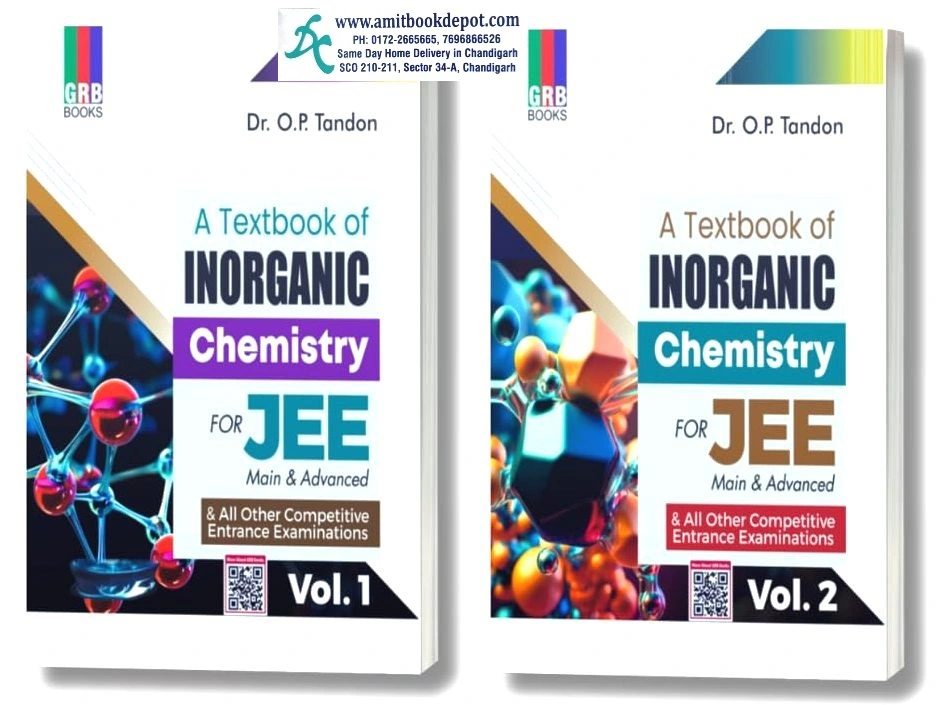
Master Inorganic Chemistry for JEE Main and Advanced with the GRB A Book Of Inorganic Chemistry Programme (Set of Two) by Dr O. P. Tandon. This two-volume set delivers exhaustive coverage of periodic properties, chemical bonding, coordination compounds, and qualitative analysis. Designed as a complete JEE preparation programme, it integrates theory with practical chemistry and volumetric analysis. The book systematically addresses s-block, p-block, d-block, and f-block elements, along with metallurgy and environmental chemistry. Ideal for building conceptual clarity and problem-solving speed, this revised edition is a staple for engineering aspirants seeking a high score in the JEE inorganic section.
Yes. It covers periodic properties, chemical bonding, s/p/d/f blocks, coordination compounds, metallurgy, and qualitative analysis for both exams.
Yes. Each chapter integrates solved JEE Main and Advanced problems alongside step-by-step explanations for effective practice.
Yes. The f-block elements chapter explains lanthanide contraction, its consequences on atomic radii and basicity, with examples.
Yes. Detailed coverage of VSEPR, MOT, hybridization, bond order, and paramagnetism is provided with diagrams.
Yes. A full chapter on volumetric analysis includes acid-base, redox, and complexometric titrations with numerical problems.
Yes. A complete chapter on environmental chemistry discusses pollutants, smog, ozone layer, and green chemistry.
Yes. The qualitative inorganic analysis chapter covers group separation, interfering anions, and confirmatory tests systematically.
Yes. It explains geometrical and optical isomerism, IUPAC naming, VBT, and CFT with crystal field splitting diagrams.
Yes. Two full chapters detail their properties, compounds, diagonal relationship, and anomalous behaviour of lithium and beryllium.
It expands NCERT with JEE-level problems, deeper bonding theories, advanced coordination chemistry, and exhaustive metallurgy coverage.
Yes. It covers periodic properties, chemical bonding, s/p/d/f blocks, coordination compounds, metallurgy, and qualitative analysis for both exams.
Yes. Each chapter integrates solved JEE Main and Advanced problems alongside step-by-step explanations for effective practice.
Yes. The f-block elements chapter explains lanthanide contraction, its consequences on atomic radii and basicity, with examples.
Yes. Detailed coverage of VSEPR, MOT, hybridization, bond order, and paramagnetism is provided with diagrams.
Yes. A full chapter on volumetric analysis includes acid-base, redox, and complexometric titrations with numerical problems.
Yes. A complete chapter on environmental chemistry discusses pollutants, smog, ozone layer, and green chemistry.
Yes. The qualitative inorganic analysis chapter covers group separation, interfering anions, and confirmatory tests systematically.
Yes. It explains geometrical and optical isomerism, IUPAC naming, VBT, and CFT with crystal field splitting diagrams.
Yes. Two full chapters detail their properties, compounds, diagonal relationship, and anomalous behaviour of lithium and beryllium.
It expands NCERT with JEE-level problems, deeper bonding theories, advanced coordination chemistry, and exhaustive metallurgy coverage.