-
Mon-Fri: 10AM to 8PM 01722665665
-
My Account
-
-
0
Total :
₹ 0.00

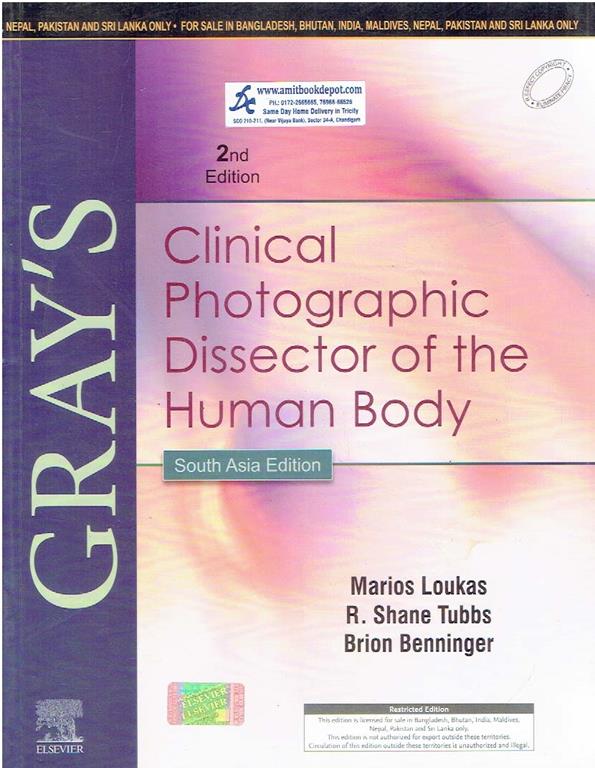
Grey’s Clinical Photographic Dissector of the Human Body, by Marios Loukas, Brion Benninger, and R. Shane Tubbs, is a visually rich, hands-on guide from Elsevier designed for success in the dissection lab. This resource replaces traditional illustrations with high-quality photographs to depict anatomy with clinical realism. Organised by region—including the thorax, abdomen, upper limb, lower limb, and head and neck—it provides clear dissection instructions and integrates clinical applications to bridge anatomical concepts with medical practice. An essential tool for mastering gross anatomy, preparing for practical exams, and building a foundation for clinical rotations.





It uses high-quality, full-color photographs to show anatomical structures as they appear in the actual dissection lab.
The book covers the back, thorax, abdomen, pelvis, upper limb, lower limb, and head and neck.
Yes, the first chapter covers dissection laboratory materials, tools, and techniques to prepare students.
The book follows a regional approach, systematically guiding students from the back to the head and neck.
Yes, it includes detailed chapters on the orbit, ear, nasal cavity, larynx, and infratemporal fossa.
Yes, the pectoral region and female breast are thoroughly examined in the thorax section.
The upper limb section covers the axilla, arm, forearm (anterbrachium), and hand.
It includes a dedicated chapter on the heart, as well as coverage of the lungs and mediastinum.
The integration of clinical applications and clear visual identification of high-yield structures aids exam preparation.
It provides comprehensive coverage of the gluteal region, thigh, leg, ankle, and foot.
It uses high-quality, full-color photographs to show anatomical structures as they appear in the actual dissection lab.
The book covers the back, thorax, abdomen, pelvis, upper limb, lower limb, and head and neck.
Yes, the first chapter covers dissection laboratory materials, tools, and techniques to prepare students.
The book follows a regional approach, systematically guiding students from the back to the head and neck.
Yes, it includes detailed chapters on the orbit, ear, nasal cavity, larynx, and infratemporal fossa.
Yes, the pectoral region and female breast are thoroughly examined in the thorax section.
The upper limb section covers the axilla, arm, forearm (anterbrachium), and hand.
It includes a dedicated chapter on the heart, as well as coverage of the lungs and mediastinum.
The integration of clinical applications and clear visual identification of high-yield structures aids exam preparation.
It provides comprehensive coverage of the gluteal region, thigh, leg, ankle, and foot.